Pascal's wager
-----------------
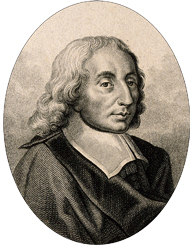
In the 17th century, Blaise Pascal invented the calculus of probability while solving a problem posed by the Chevalier de Méré. Carried away by his own enthusiasm, he applied probability to our conduct of life: if we bet on the existence of God, we must sacrifice our life by following the rigid divine commandments in order to win eternal life in paradise. If we bet on the nonexistence of God, we "win" our life by living in debauchery and selfishness, but we risk suffering the torments of hell until the end of time.
--------------------------
Let's read the Pensées: "Let us weigh the gain and the loss (…) if you win, you win everything; if you lose, you lose nothing. Wager, then, that He is [God], without hesitating."
What is troubling is the "you lose nothing". Pascal believes the value of life is close to zero, and the expected value tied to a pious life that wins paradise is the product of a quantity tending toward zero and a quantity tending toward infinity. The result is indeterminate!
Mathematically, the reasoning does not hold, and theologically, it is questionable. We had come to expect better of Pascal. The Christian God, however, might be troubled by this utilitarian reasoning. Thus Jansenism, of which Pascal was a zealous adherent, condemned attrition, in which the penitent confesses his sins out of fear of hell, as opposed to contrition, in which the penitent regrets his errors out of love of God.
-
What Pascal actually thought…
----------------------
Although the author of the Pensées did not present his "Pascal's wager" as an argument in favor of the existence of God, the confusion can arise. In reality, the wager offers no reason to believe that God actually exists. It offers a reason to believe that it is advantageous to believe in God, whether or not He exists. Let's reread Pascal more closely:
"Let us then examine this point, and say: "God is, or He is not." But which way shall we lean? Reason cannot decide the matter: an infinite chaos separates us. A game is being played, at the far end of this infinite distance, where heads or tails will come up. What will you wager? By reason, you can defend neither the one nor the other; by reason, you can refute neither of the two. So do not blame those who have made a choice for being wrong; for you know nothing about it.
– No; but I will blame them for having made, not this choice, but a choice; for although the one who chooses heads and the other are equally at fault, they are both at fault: the right thing is not to wager at all.
– Yes, but you must wager; it is not optional, you are already committed. Which will you take, then? Let us see. Since you must choose, let us see what matters least to you. […] Your reason is no more offended by choosing one than the other, since you must necessarily choose. That point is settled. But your happiness? Let us weigh the gain and the loss, taking heads that God exists. Let us estimate these two cases: if you win, you win everything; if you lose, you lose nothing. Wager, then, that He exists, without hesitating."
-
The Saint Petersburg paradox
-------------------------------
The name of the city of the Romanovs remains attached to that of a mathematical paradox. Peter Ist the Great, wishing to bring luxury to his new capital, attracted scientists there. Nicolas and Daniel Bernoulli met there in 1725. It was then that they devised the following game: a player tosses a fair (unrigged) coin until getting heads. Let n denote the number of times the player gets tails before getting heads. He then wins 2*n* euros.
Since the expected value of this experiment is infinite, the player should, logically, be willing to wager any amount to take part. Yet no one would invest more than a few euros in a single game!