Life's decisions should, consciously or otherwise, be based on expected value, which reflects our desire for gain. It is defined as the product of the potential payoff and the probability of winning it. Its shortcomings and flaws are worth assessing, even if finding a substitute is difficult.
Overestimating favorable outcomes
====================================
First, bear in mind that we overestimate the probability of favorable events relative to unfavorable ones. We treat the probability of being run over by a car while crossing the street as negligible (which is why we cross the street!), yet we buy a EuroMillions ticket even though the probability of hitting the jackpot is immensely smaller.
This assessment of probability gives rise to a first paradox. In the two-wallet wager, two opponents stake their respective wallets, containing
M euros and N euros. The player with less money in their wallet takes the contents of the other's. Player 1 believes that he has a probability of 1/2 of winning the wallet containing more money than his own and that his expected value is greater than his opponent's. The paradox is that player 2 tells himself exactly the same thing, and they both place the wager, even though they cannot each have an expected value strictly greater than the other's... The flaw in the reasoning is that the probability of 1/2 expresses our ignorance rather than corresponding to a measured value. Incidentally, if both players prepare for the game, they will empty their wallets, and the winner will receive only a paltry sum...
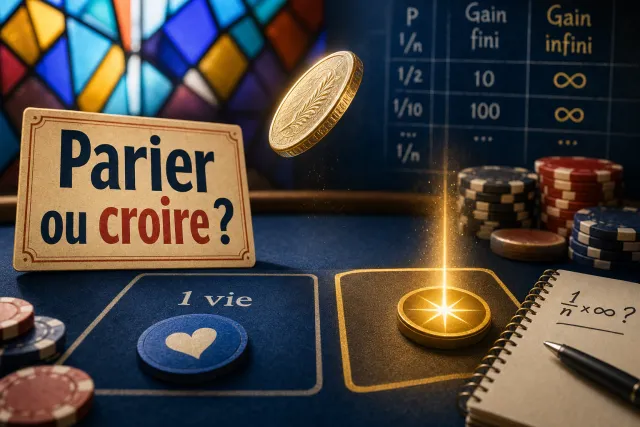
According to Pascal, we must wager because "we are embarked" upon life (such is the drawback of having been born, wrote Emil Cioran). The French scholar urges us to wager that God exists, because submitting to his commandments will secure eternal life for us. Our stake—our finite life—is infinitely smaller than our infinite expected value, provided that the probability of God's existence is not zero (though assigning a probability to a metaphysical possibility is difficult...) and that we believe the promises of paradise. The tragedy is that, far from being an encouragement to a pious and benevolent life, Pascal's wager is also a driving force behind murderous terrorism. So what are we to make of it?