The famous British economist John Maynard Keynes (1883–1946) set out the following principle in 1921 in his book A Treatise on Probability: "If there is no known reason to prefer one of several possible alternatives to another, then, given what we know, those alternatives are equally probable. Equal probabilities must therefore be assigned to the different possibilities unless there is reason to assign them unequal probabilities."
Under the name principle of indifference, which may bring to mind maximum entropy or the principle of parsimony (see box), Keynes gave a name to an idea Pierre-Simon Laplace had already discussed in 1840 in his Essai philosophique sur les probabilités (Philosophical Essay on Probabilities). At the time, it was called insufficient reason (or the principle of insufficient reason), and Laplace illustrated it with the familiar game of heads or tails (see Tangente 175) "Consider a coin toss [today, heads or tails], and suppose that either side of the coin is equally likely to come up. Then the probability of getting heads on the first toss is 1/2, and that of getting heads twice in succession is 1/4. But if the coin has some asymmetry that makes one side more likely to come up than the other, without our knowing which side is favoured by that asymmetry, the probability of getting heads on the first toss will still be 1/2; for, since we do not know which side the asymmetry favours, the probability of the simple event is increased by just as much when the asymmetry favours it as it is decreased when the asymmetry works against it." For Laplace, assigning equal probabilities to the two sides of a coin is either an assumption or a logical consequence of our ignorance: the coin may be assumed to be "fair," or it may be assumed to be "biased," but we do not know how. In either case, he thought, equal probabilities should be assigned to the two possible outcomes… You will no doubt conclude that applying Keynes's principle to Laplace's coin leads to equal probabilities for heads and tails. But if the example becomes more complicated, will you still subscribe to the principle of indifference?
Origins of a controversy
=========================================================================
The principle of indifference has prompted numerous objections, with each critic devising ever more ingenious scenarios in which applying it leads to a contradiction or paradox. Let's begin with a relatively recent problem, dating from… 1989. The Dutch philosopher Bastiaan Cornelis van Fraassen poses the following problem:
*"A precision-tool factory produces iron cubes with edge lengths of less than 2 cm. What is the probability that a cube has an edge length of less than 1 cm, given that it was produced by this factory?
A naive application of the principle of indifference treats edge length as a parameter and assumes a uniform distribution. The answer is then 1/2. But the problem could be stated in different, though logically equivalent, terms:*
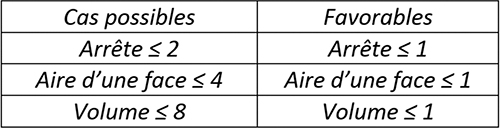
Applying the same reasoning to each formulation of the problem, we naively obtain the answers 1/2, 1/4, and 1/8. But they contradict one another!"