




This issue is not fully translated into English yet; only translated content is shown.
Read the French versionAll folders in this issue
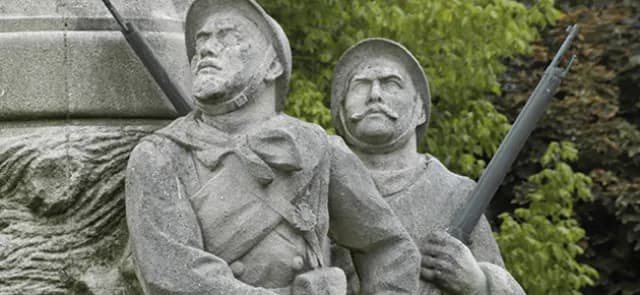
Mathematicians in the Great War
Mathematics played, from start to finish, a significant role in this, one of the deadliest conflicts that was the Great War. Thus, the mathematician Paul Painlevé was involved in developing aviation and organizing operations research which made it possible to best conduct the war. And it is to the tenacity of a brilliant cryptanalyst, Georges-Jean Painvin, that we owe the decryption of the key telegram which would lead the Allies to victory! This conflict, from which many mobilized mathematicians did not return (René Gâteaux and André-Louis Cholesky in France, Eugenio Levi in Italy...) also had very damaging consequences on international scientific cooperation.
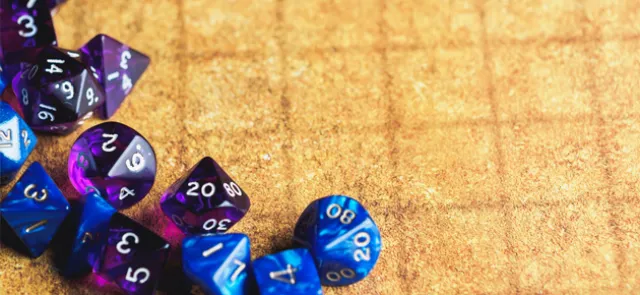
The hidden side of probabilities and statistics
Students know this well: understanding probabilities and statistics often requires an adaptation period. Who has never confused correlation and causation? Chance being by nature unpredictable, how can we hope to build certainties on it? Even more surprising: how to create models on unpredictable phenomena? Our intuition being severely tested, paradoxes follow one after another, which the entertainment world (casinos, board games, media, card games or games of chance...) has known how to take advantage of. But taming chance even just a little brings powerful tools in a world where everything is connected: internet users' choices, online reservations, detection of unsolicited electronic mail rely on a theorem discovered three hundred years ago by an English theologian named Thomas Bayes.

All articles in this issue
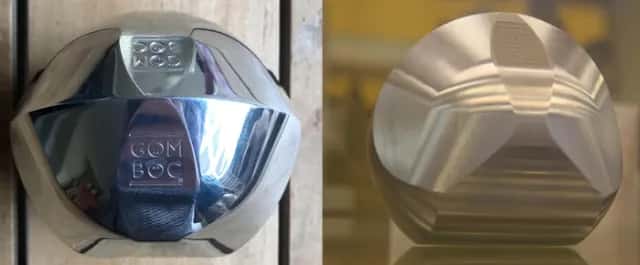
The Gömböc, that obscure object of geometrical desire
An okiagari-koboshi, or Japanese roly-poly toy, is designed always to return to an upright position. This traditional lucky doll symbolizes perseverance—a quality that two Hungarians displayed in abundance when proving the existence of a homogeneous body with the same property.
Walloon of the Year award goes to Emmanuel Houdard
The 2017 Walloon of the Year Award has just been presented to mathematics teacher Emmanuel Houdart, director of the Maison des maths in Quaregnon, Hainaut, Belgium, near the French border.

National Order of Merit for Houria Lafrance
A tireless mathematics popularizer has just been honored. Houria Lafrance, president of the association "Les maths en scène," has been appointed a Knight of the National Order of Merit.
APMEP's promising new publication
At last, the new journal of the Association des professeurs de mathématiques de l'enseignement public (APMEP) has arrived!

The ever-surprising curiosities of the harmonic series
The harmonic series is one of the few divergent series that frequently arises in science. In mathematics, naturally, but not only there: it also turns up in a theater, in the guise of an absent-minded spectator who has forgotten his seat number, and in problems involving stacks of sugar cubes.

Tip-top: the tippe top!
In playgrounds, the tippe top is often called a "magic top" because it flips itself over, turning upside down. Its counterintuitive behavior is subtle...

Kinetic art returns
The last time Argentine sculptor and painter Julio Le Parc exhibited in New York was in 1973. The artist has just brought a successful exhibition in Paris to a close at the Perrotin gallery in the 3rd arrondissement. In the meantime, kinetic art had faded from view.

Could nature be mathematical?
Another form of optical art is found in the famous crop circles, or "crop formations" (technically known as agroglyphs). These geometric patterns, most often created in cereal fields, range in size from a few square metres to several hectares. They are made by cutting, twisting or bending stalks of grain, usually at night and in record time.

Archimedes' time
Once again, we turn to a "spiral"—not in a field or on a canvas, but… inside a watch.
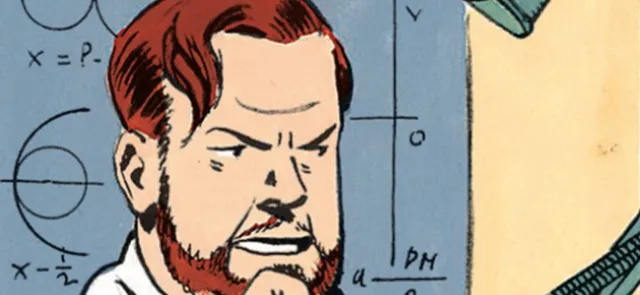
Blake and Mortimer: the professor takes up maths
Scientists are rare among comic-book heroes. Mathematicians are rarer still! One of the most famous scientists among them is Professor Philip Mortimer, from the "Blake and Mortimer" series. Let's examine his relationship with the queen of the sciences.

A closer look at mental arithmetic
A mass-circulation weekly takes a look at mental arithmetic!