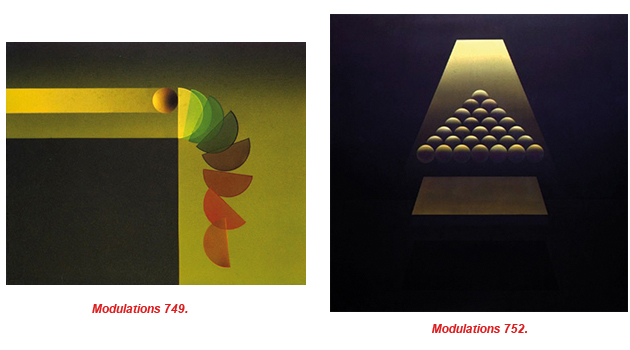
Today, by contrast, other abstract artists, such as Hans Hartung, Pierre Soulages, Jesus Rafael Soto with his virtual volumes, and Park Seo-bo with his sequences of parallel lines, are once again finding favor with art lovers. All embrace geometric forms or kinetic representations.
Victor Vasarely and Piet Mondrian, whose work is no stranger to geometric forms, were the first to capture Julio Le Parc's interest when he arrived in France in 1958. Around 1960, Le Parc went on to found GRAV (Groupe de recherche sur l’art visuel) with François Morellet and others. Drawing heavily on geometry and often constructed as sequences or “progressions” to produce optical effects, Le Parc's works—with evocative titles such as Cercles en contorsion sur trames, Cercles par déplacement, Ondes, and Volume virtuel—prove once again that mathematics and art are closely intertwined.