Bauhaus2
-------------------
The Bauhaus—an art, design and architecture school founded in Weimar, Germany, by architect Walter Gropius in 1919—steered art toward functionalism, stripping forms down to the bare geometric minimum: triangle, circle and square. Opponents of the movement, with its unprecedented use of such forms, criticized this "dictatorship of the square." Even Paul Westheim, an art critic and advocate of modern art in Germany, went so far as to write in his journal Kunstblatt: "Three days in Weimar, and you can no longer stand the sight of a square. Malevich invented the square in 1913—thank goodness he did not patent it!".
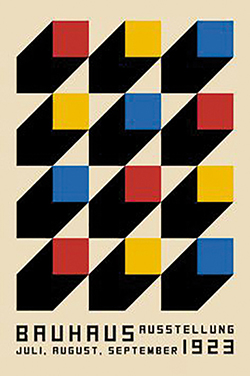
Poster for a 1923 Bauhaus exhibition.
Homage to the square
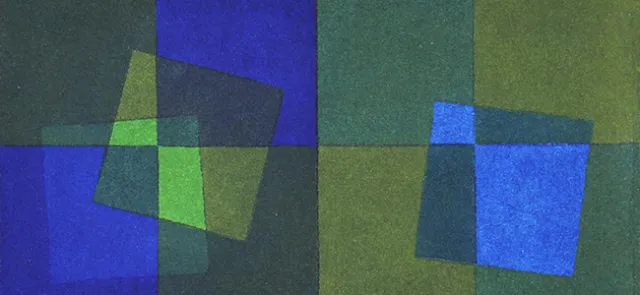
A painter, draughtsman and photographer, Josef Albers (1888–1976) is regarded as one of the forerunners of Op Art. He taught at the Bauhaus from 1920 to 1933, before emigrating to the United States after Nazi Germany closed the school. Beginning in 1949, he produced a series of more than a thousand works entitled Homage to the Square, all composed of nested squares. Because the perception of color was essential to him, Albers sought to study chromatic interactions precisely, without allowing the choice of shape to distract the eye. He therefore chose the square, a neutral outline that would not interfere with the perception of color. The resulting effects are striking and vary from work to work: floating squares, intermingled squares, or a dominant square at the center of the painting—a richly deserved homage to the celebrated quadrilateral.
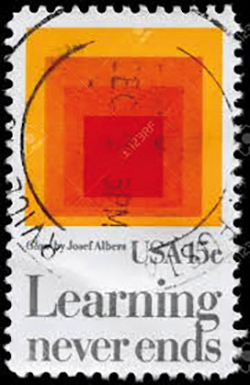
US postage stamp featuring Homage to the Square.
Aurélie Nemours's squares
----------------------------
Another artist fascinated by the square, which she placed at the heart of her work, Aurélie Nemours (1910–2005) created works defined above all by geometric abstraction. From 1953 onward, this painter, printmaker and sculptor confined her compositions to vertical and horizontal lines, necessarily producing juxtapositions of squares and rectangles in contrasting colors. In 1989, near Stuttgart in Germany, she exhibited Le Long Chemin, a series of monochrome square canvases extending over more than fifty meters. Then, in 1990, she created Stèle for the Manufacture de Sèvres, using stacked squares. Throughout almost her entire career, Aurélie Nemours sought to "give emptiness a place" and succeeded in elevating the square to new heights. An extraordinary retrospective of her work was held at the Centre Pompidou in Paris in 2004.
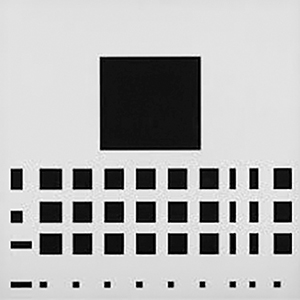
Translation, screen print on paper, Aurélie Nemours, 1973.
Squarely fake
-------------------
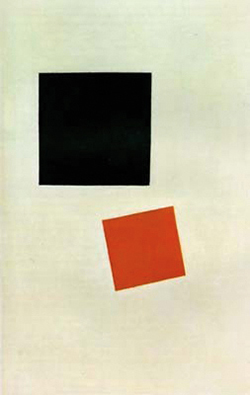
As Paul Wertheim said, Kasimir Malevich had invented the square before the Bauhaus when he created his Black Square on White Ground as a sketch for a Futurist opera in 1913. He continued along the Suprematist path—the Russian art movement he founded—with his celebrated White Square on White Ground in 1918 and Black Square, Red Square in 1915. This last painting, donated to Düsseldorf's Kunstsammlung Nordrhein Westfalen museum in 2015 and valued at between €50 million and €80 million, turned out two years later to be... a fake. So not only may Malevich's squares—which he himself preferred to call "quadrangles"—not have been entirely square, but some of these "pseudo-squares" are fake as well!