"Nothing is more concrete, more real than a line, a color or a surface." This thoroughly Platonic statement by Theo van Doesburg (the pseudonym of Christian Emil Marie Küpper, 1883–1931), founder of numerous avant-garde art movements, will disabuse anyone who might interpret "concrete" as the opposite of "abstract."
Why is there an Espace de l'art concret in a small town in the Alpes-Maritimes, between Grasse and Cannes, where nature would seem more likely to inspire figurative art? The answer lies in the meeting of André Aschiéri, a mayor and mathematics teacher with an open mind toward contemporary art, and Gottfried Honegger (1917–2016), a Swiss collector and artist. Honegger and his wife, Sybil Albers, donated their personal collection of four hundred works to the French state. The works have since been exhibited at the Espace de l'art concret in Mouans-Sartoux, in a purpose-built setting designed by architect Marc Barani.
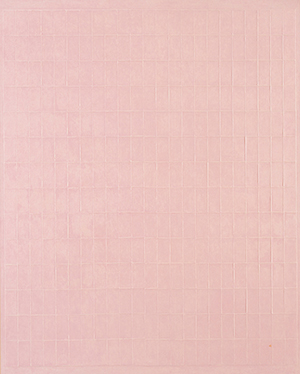
Relief Painting Z.826. The relief effect is created by light reflecting differently off the painting's various small rectangles.
-
The role of mathematics and optics
------------------------------------------
Mathematics is everywhere from the very first gallery. For mathematics enthusiasts, Max Bill's (1908–1994) painting Two Zones, Light and Dark will above all evoke the irrationality of the square root of 2. The work depicts the proof given in Plato's Meno. The gallery also contains classical rhythms, including canvases based on ratios between areas of different colors or on alignments.
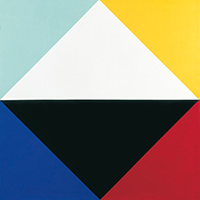
Zwei Zonen, dunkel und hell.
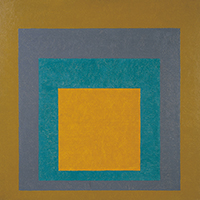
Far off, study for homage to the square.
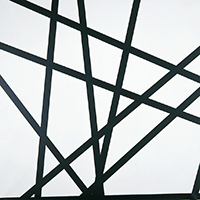
Ten random lines.
Josef Albers's (1888–1976) main aim in his homage to the square, however, is to trap the viewer's eye among the colors of the different squares, making the palest, central square appear to float at the heart of the composition. Many of the paintings are similarly based on a kind of optical illusion that leaves the eye caught between several interpretations.
-
The aesthetics of chance
----------------------
François Morellet (1926–2016) uses a surprising technique to create some of his works: chance. Looking at his canvases, you might wonder whether he used chance several times and then selected the "most aesthetically pleasing" result—which comes close to negating chance altogether. What is the probability that, among ten lines, four are approximately concurrent, forming a beam reminiscent of a spotlight? The question may well arise, but no matter: only the result counts. The painting possesses an undeniable harmony, again arising from the viewer's uncertainty between different interpretations.

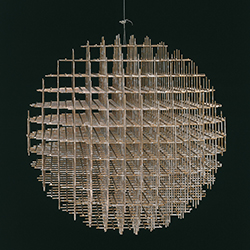
Grid sphere.
François Morellet also invented the theory of "viewer participation." Both the viewer's gaze and light lie at the heart of art in general, and of concrete art in particular. Their importance becomes clear in his sculptures, such as this stainless-steel sphere cut along two sets of parallel planes perpendicular to each other. Every movement of the viewer and every variation in the light reveals a different latticework. The photograph opposite will undoubtedly inspire mathematicians.
David and Royden Rabinowitch, twin brothers born in 1943, work together but sometimes sign their works independently. This explains why you may encounter very similar sculptures signed by one brother… or the other. The Espace de l'art concret owns one of the sculptures signed by David. Mathematicians may find it inspiring, even if they find it puzzling.
Conical plane in four masses and two scales.
The lines drawn on the ellipse opposite evoke Pascal's mystic hexagram. Yet this interpretation is wrong: the conic contains only three lines, not six. Furthermore, the holes pierced in the surface are then highly mysterious, seemingly distributed at random. If the four masses can be found, where are the two scales? The apparently very precise title invites viewers to count, only to leave them lost among several interpretations…