Morellet exhibition in Avignon until the end of October
----------------------------------------------------------
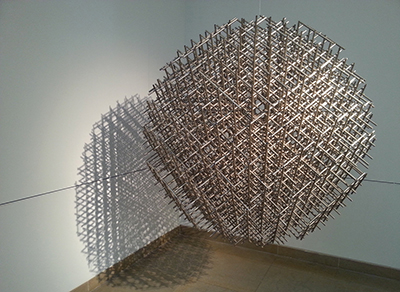
From 1952 onward, following his encounter with the work of concrete artist Max Bill, François Morellet (1926–2016) set out to create simple geometric structures, optical effects, inflections of lines and visual puzzles using mathematical algorithms or random sequences of digits. Morellet played with lines, chance, words and the eyes of his audience. He would systematically establish a founding principle, then allow the creation of a painting, sculpture or installation to unfold… The result was deliberately unpredictable: sometimes magnificent, sometimes unremarkable, but never banal.
A pioneer of geometric abstraction, he founded GRAV (Groupe de recherche d'art visuel) with Horacio Garcia Rossi, Julio Le Parc, Joël Stein, Francisco Sobrino and Jean-Pierre Yvaral (Vasarely's son), and became one of the leading figures of kinetic art in France.
The exhibition "L'esprit de suite," on view at the Musée Angladon in Avignon (5 rue Laboureur) until October 28, Tuesday to Saturday from 1 p.m. to 6 p.m., traces the career of the "monstrous son of Mondrian and Picabia" through the artist's prints, paintings, sculptures and books.
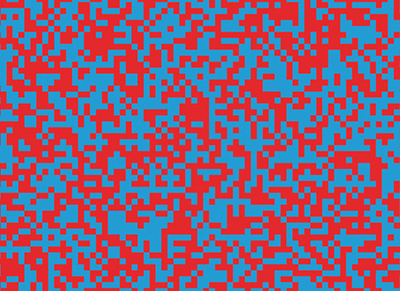
A painting of four thousand squares whose color (blue or red) is determined by the parity of telephone numbers in a directory.
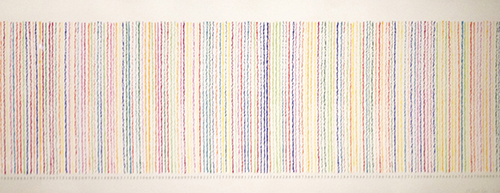
A painting in which the colors of the vertical lines correspond to the decimal digits of π.
How can Morellet's comments be silenced?
-----------------------------------------
This book encapsulates a passion, an unconventional approach to art and a lifelong commitment to a new vision of artistic creation—in short, a life. Its punning title reflects Morellet's way of working with geometric figures, lines, colors, 3D objects, electrical components and neon lights—all of which served as the atoms of his works.
The seemingly independent texts were written by Morellet for himself or, more often, for written or face-to-face exchanges he had over sixty years with figures in the art world, including Vasarely and Vera Molnar. One conviction is clear: today's art is no longer yesterday's; above all, the artist composes works that, once their underlying principles have been established, can be interpreted by (almost) anyone. "My guiding principle: do as little as possible. Or, to put it in art-book language: reduce my arbitrary decisions to a minimum."
*
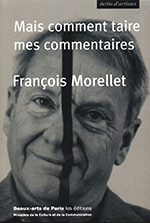
Mais Comment taire mes commentaires.* François Morellet, Éditions Beaux-arts de Paris, 320 pages, 2003, 18 euros.
More than a catalog: an art book
--------------------------------
This magnificent catalog for the exhibition "L'esprit de suite" (first presented at the Musée des beaux-arts de Caen in September 2015) groups dozens of works into series, each introduced by a text in which the artist explains his choices and creative philosophy. He sets out the "systems" that generate his random paintings and allow others to reproduce them, and describes his relationship with the various printing techniques he employed, whose limitations he sought to transcend so that he could integrate those techniques into his works. This included his intimate, late-blooming relationship with the "shoddily made," which he initially rejected in favor of screen printing, a technique capable of producing neutral, precise results.
His grids, squares, folds, curves, lines, overlays and stamped patterns are presented here alongside the artist's underlying exploration, always guided by the principle that art lies in the eye of the beholder. Beyond the interplay of geometric forms and chance, mathematicians will recognize the approach of defining works through creative rules that anyone can reproduce and will find themselves on familiar ground.
The book opens with a conversation between the artist and Lauren Laz, director of the Musée Angladon in Avignon, where the current exhibition is being presented.
*
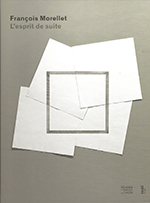
François Morellet. L'esprit de suite.* Edited by Caroline Joubert, Fage Éditions, hardcover, 144 pages, 2015, 28 euros.