Some artistic fields lend themselves more readily than others to games of self-reference. Theatre is particularly well suited to them. Among the classics, Shakespeare's Hamlet is a case in point, as are Corneille's L'Illusion comique, Chekhov's La Mouette and Pirandello's Six personnages en quête d'auteur—not to mention Diderot's Le Paradoxe du comédien, or the alienation effect in Brecht's epic theatre, which consists in interrupting one narrative with another. Read them again!
Inspired contemporary artists
---------------------------------------
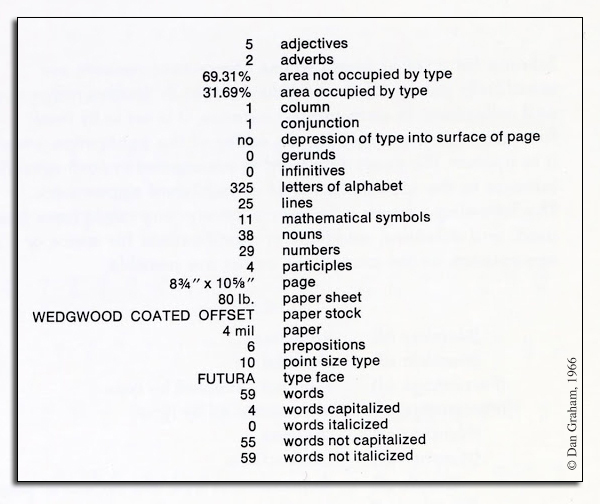
Poem schema, Dan Graham, 1966–1969.
From 1966 to 1969, American artist Dan Graham (born in 1942) published several self-referential poems in art magazines, anticipating by several years similar research that would be conducted using computers. The template for his Poem schema was anything but sentimental, belonging instead to the "icy waters of egotistical calculation": in a single column, it listed the numbers of adjectives, adverbs, lines, letters, capital letters, numbers and so on in the poem itself—and nothing else. Graham may one day be dubbed an "artist of deferred self-reference" for his extraordinary 1974 works Time Delay Room and, above all, Present Continuous Past(s). This installation consists of two mirrors, a video camera and a monitor, and uses a system of loops and delays so that viewers see themselves on the screen from different angles… as they were a few moments earlier.