



Bewildering discontinuity
This issue is not fully translated into English yet; only translated content is shown.
Read the French versionAll folders in this issue

Discontinuity
Breaking with the search for regularity in scientific phenomena, the interest in discontinuous functions suddenly appeared at the beginning of the 19th century with the study of Fourier series. Greater rigor was then imposed to define the concepts of function, continuity, differentiability. Riemann, Lebesgue, Darboux and others proposed examples of monstrous functions to justify the interest in the theories they had developed, opening the field to new approaches in physics and even economics.


Circular reasoning
Georg Cantor and his set theory shook the foundations of mathematics by highlighting circular reasoning, that is to say, self-referential. At the turn of the 20th century, his paradoxes emerged under the pen of Burali-Forti, Russell and Richard, throwing Frege into dismay. Kurt Gödel showed that certain assertions cannot be proved or disproved within a given axiomatic framework, bringing a negative answer to a famous problem posed by Hilbert. Self-reference is also found in literature, painting, sculpture and… in the press where, intentional or not, it makes us smile.


All articles in this issue

Who (really) holds power in Parliament?
In May 2019, following the European Parliament elections, some groups gained seats, but not enough to influence the debates. Others lost seats, yet still seem indispensable. A group’s real power cannot be reduced to its number of seats!

Welcome to 2020!
As usual, the new year inspired the Tangente team and their friends, who all vied with one another to tease out the number 2020's astonishing properties.

An aberration: the discontinuity in mathematics education
In France, every reform reduces the opportunities for students on non-science tracks to study mathematics.

Laure Saint-Raymond, 2020 Bôcher Prize winner
The American Mathematical Society (AMS) has just awarded the 2020 Bôcher Prize to French mathematician Laure Saint-Raymond, a professor at ENS Lyon and a member of the Académie des sciences, for her "transformative contributions to kinetic theory, fluid dynamics and Hilbert's sixth problem."

Wanted: a missing abacus
An ancient Roman ivory abacus has been missing for several years.
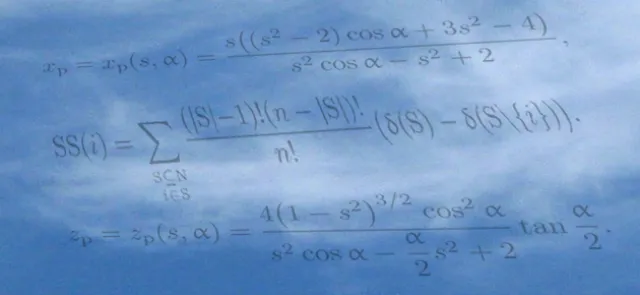
Words and mathematics
Symbols and formulas emerged only gradually from mathematics that was initially expressed entirely in words. Ever since, the relationship between formalism and ordinary language has continued to fascinate.

Should you choose mathematics as a specialization in 11th grade?
Parents of tenth-grade students who do not have a high-school mathematics teacher among their close acquaintances often wonder which specializations their children should choose in 11th grade. In particular, is taking mathematics a wise choice?
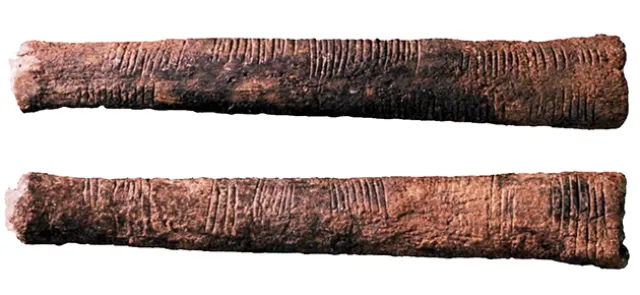
When numbers awoke to wonder
Ancient peoples used numbers for purely practical purposes: to count and enumerate. Five centuries before the Common Era, after travelling the world, a Greek scholar named Pythagoras returned certain that the original order of the World was Number, thereby turning it into a philosophical concept.