Antoine Rolland (third from the left) receives his Trophy, created by Denise Demaret-Pranville, in the presence of Gilles Cohen, Frédéric Jaëck and Bertrand Hauchecorne. He is a senior lecturer in statistics at Université Lyon-II.
In the country of Democrystan, Parliament consists of ninety-nine members. To pass, a bill must receive a majority of the votes and therefore be approved by at least fifty members. Only three parties hold seats: Party A has forty-nine, Party B also has forty-nine, and Party C has just one. Suppose that the members are disciplined, with everyone in each party voting the same way. Neither A, B nor C has an absolute majority on its own, but any coalition of two parties is winning. In this configuration, the three parties are interchangeable and therefore have the same power… despite having very different numbers of seats!
When losing pays off
-----------------
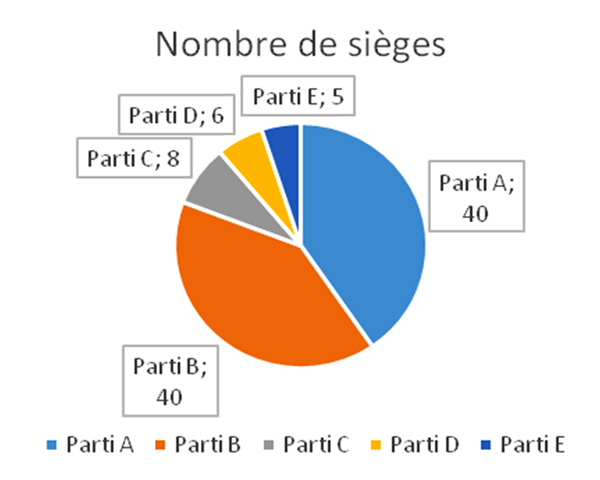
New elections are held, and two additional parties enter the race. The results give Party A forty seats, Party B forty, Party C eight, Party D six and Party E five. The coalition {A, B} is still winning, but {A, C} and {B, C} are no longer winning. For either of the two “major” parties, A and B, an alliance with C alone is no longer enough to form a winning coalition: D or E must now also be part of it. C is therefore less powerful than before. Thus, Parties A and B, which lost seats, retained the same power, whereas Party C, which gained seats, lost power!
The (simplified) example of Democrystan shows that a party’s power cannot be determined solely from its number of members. To capture this notion of power as accurately as possible, several “indices” have been developed in game theory.
To define general “power indices”, consider a situation in which n individuals, with respective weights w1, w2… *wn , take part in a simple-majority voting process. A coalition is then a set of individuals, and the coalition is winning* if the sum of its members’ weights exceeds half the total weight. In Parliament, the individuals are parties, and their weights correspond to the number of members in each party.

John Banzhaf (born 1940).
A very simple power index was proposed in 1965 by John Banzhaf, an American legal scholar concerned with fairness and justice. It is based on the notion of a “critical player”. Within a winning coalition, a player is critical if the coalition would no longer be winning without that player. A player’s Banzhaf index is the number of winning coalitions in which that player is critical. Their normalized Banzhaf index is obtained by dividing their Banzhaf index by the sum of all the players’ Banzhaf indices, so that the sum of all their normalized indices is 1.
In the original Democrystan scenario, Party A is critical in both coalitions {A, B} and {A, C}; its normalized Banzhaf index is therefore 1/3, as are those of B and C: all three parties have the same power index. After the elections, A’s power index, like B’s, is 2/7, while those of C, D and E are 1/7: the power of A and B has therefore fallen slightly. C’s has fallen sharply, even though it has more members than before.
Other power indices are possible. In 1954, Lloyd Shapley and Martin Shubik, then at Princeton University (New Jersey, United States), had already proposed one for calculating an individual’s power within a coalition. Consider all permutations of the players. If there are three players, for example, A, B and C, there are six permutations: ABC, ACB, BAC, BCA, CAB and CBA. In general, there are n! = 1 2 … n. For each permutation, add the players’ weights in order until the total strictly exceeds half the sum of all the weights—that is, until the initial terms of the permutation form a winning coalition. The player whose addition first takes the total past this threshold is the pivotal player in that permutation. A player’s Shapley–Shubik index is the number of permutations in which they are pivotal, divided by the total number of permutations, namely n!. This normalizes the index so that all the Shapley–Shubik indices sum to 1.
Return to Democrystan: with only three parties, the situation is symmetric and each party is pivotal in two of the six possible permutations. The Shapley–Shubik indices of A, B and C are therefore all 1/3. After the elections, consider the 120 possible permutations of the five parliamentary groups: A is pivotal in thirty-six permutations, as is B, while C, D and E are each pivotal in sixteen. The Shapley–Shubik indices are therefore 9/30 for A and B and 4/30 for C, D and E.
The mathematical properties of power
-------------------------------------------
In a 2003 article (la Mesure du pouvoir de vote, Mathématiques et Sciences humaines 163), Nicolas-Gabriel Andjiga, Frédéric Chantreuil and Dominique Lepelley surveyed nearly ten different power indices and showed that they could all be expressed in a general form by counting the coalitions in which an individual is critical and assigning each of these coalitions a specific weight (see box).
Studying power indices reveals several technical properties. If an individual a has greater weight than b, then their power cannot be less than that of b (the monotonicity property). If a transfers some of their weight to b, then the power of a cannot increase (the transfer property). If a and b form a bloc—that is, if they act as a single individual whose total weight is the sum of the weights of a and b—then the power of this bloc must be at least as great as the sum of the power indices of a and b (the bloc property).
The Banzhaf and Shapley–Shubik indices satisfy all three properties. Surprisingly, the normalized Banzhaf index satisfies only monotonicity.
Requiring these properties helps avoid paradoxical situations: if one of them is not satisfied, an individual can gain weight yet lose power! In other words, it might sometimes be better not to win the elections… In fact, in game theory, an individual’s real power is not exactly equal to their weight, so it is hardly surprising that some power configurations can appear mathematically paradoxical.

Martin Joseph Shubik (1926–2018) specialized in strategic analysis.
In the European Parliament
---------------------
Leave Democrystan behind and consider the power of the various groups in the European Parliament elected in May 2019, when it was still unclear whether Britain would remain in the European Union. There were seven established groups: Group of the European People’s Party (EPP); Progressive Alliance of Socialists and Democrats (S&D); Alliance of Liberals and Democrats for Europe (ALDE), now renamed Renew Europe; Group of the Greens/European Free Alliance (Greens/EFA); Europe of Nations and Freedom Group (ENF); European Conservatives and Reformists (ECR); European United Left/Nordic Green Left (GUE/NGL). Among the non-attached members, two further coherent groups could be identified: the Brexit Party and the Five Star Movement. This gives ten different groups in all, if we make the unwarranted assumption that all non-attached members vote alike.
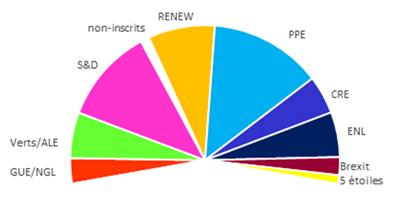
The European Parliament after the 2019 elections.
Each parliamentary group’s normalized Banzhaf index is calculated by examining the 210 = 1,024 possible subsets and identifying the critical groups in each one. The Shapley–Shubik index is calculated by examining the 10! = 3,628,800 different permutations and recording the critical group in each.
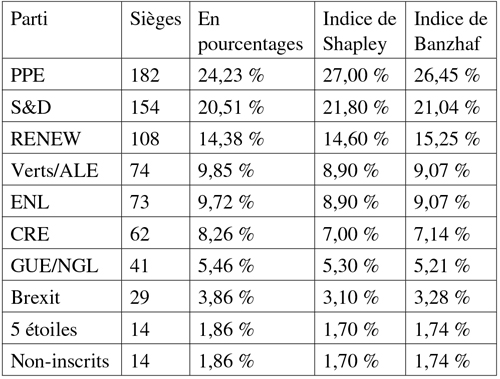
Distribution of seats by party in the European Parliament,
and Shapley–Shubik and normalized Banzhaf indices.
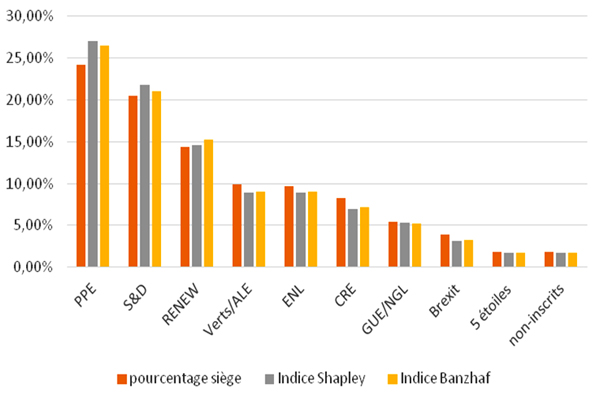
This graph compares the power indices
with the percentages of seats held by each party.
Analysis of these results (see the table) shows that the larger EPP and S&D parties wield more power in Parliament than their respective seat totals might suggest. Conversely, smaller parties such as the Greens or ENF wield less power than their share of seats would suggest. Although they are not identical, the two indices are fairly close and reflect the same reality: when the party system is fragmented, the larger parties gain power relative to the smaller ones because they are more essential to forming winning coalitions. It just goes to show that mastering the art of electioneering is not enough to win elections: you must also be at home with game theory…
This article received the 2019 Tangente Prize for best article.