Writing books or articles and developing computer programs—all centered on mathematics—is once again at the heart of the Tangente Awards. The 2019 edition was no exception, with a stronger emphasis on putting this interdisciplinary approach to work in schools. Organized by the Club Tangente, the Awards have numerous partners: CASIO calculators, the APMEP (Association of Mathematics Teachers in Public Education), the SIF (French Computer Science Society), the École normale supérieure's CultureMATH website, and Programmez ! magazine…
The Tangente Prize jury after its deliberations.
From left to right: Martine Janvier, Nathalie Juste, Bertrand Hauchecorne, Anne Boyé and Philippe Boulanger.
The Tangente Book Prize goes to Mathematikos
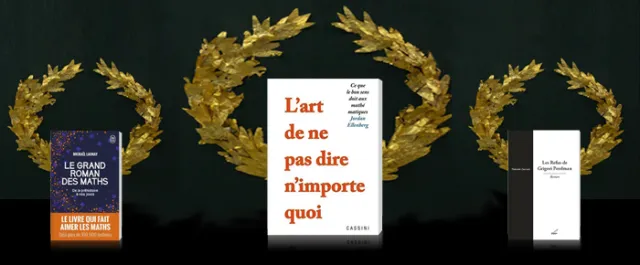
First things first: let's begin with the Tangente Book Prize, now in its eleventh year. After Alain Badiou and Gilles Haéri in 2016, Mickaël Launay in 2017 and Jordan Ellenberg in 2018, who would win the now-famous prize? It is awarded each year to a book "that has inspired a wide readership to learn more about one or more areas of mathematics".
First, online voters had chosen the "nominees" (or finalists) from twelve competing titles published in 2018 or early 2019 and reviewed in Tangente\. This year, passing over books on Big Data, artificial intelligence, chaos theory and mathematical challenges, voters instead selected five very different books: a graphic novel, a work of mathematical philosophy, a detective novel, a collection of texts from antiquity and a popular mathematics book, whose authors were for the most part little known to our readers. The jury awarded the Tangente Prize to Mathematikos*, published by Éditions des Belles Lettres.
In this book, Antoine Houlou-Garcia selected short texts on mathematics by the greatest scholars of antiquity, in French translation, and presented them by theme. The jury appreciated the selection of examples, the book's pedagogical qualities—particularly the commentary placing each extract in context—and its chronological guideposts. As the pages unfold, we come to understand the intellectual approach of an era when mathematics was an integral part of philosophy. As Poincaré, quoted by the author, puts it, "mathematics is both a way of understanding the world and marveling at the beauty of the universe, and a wonderful game from which one can derive great pleasure".
The jury awarded an honorable mention to Clara Grima's Je fais des maths en laçant mes chaussures (Éditions Les Arènes). In this book, which grew out of a successful Spanish blog, this "lover of mathematics" shows us how everyday situations, sometimes incongruous ones, can lend themselves to mathematical treatment and inspire wonder.
Despite its outstanding quality, Alain Séguy-Duclot's excellent Généalogie des mathématiques, published by Spartacus, did not win a prize. The book requires a solid background in both philosophy and mathematics, and the jury felt its level might prove daunting to some readers. Nevertheless, the editors of Tangente recommend it to anyone wishing to deepen their knowledge of the connections these two disciplines have forged over the centuries.
Despite their interesting subject matter, Emmanuel Marie and Emmanuel Cerisier's graphic novel les Oscillations de Joseph Fourier (Petit à Petit) and Ronan Quarez's detective novel Vivre avec la main d’un homme mort (Le Pommier) did not receive an award from the jury.
The Tangente High School Students' Prize goes to la Suite de Skolem
The Tangente High School Students' Prize is to the Tangente Book Prize what the Goncourt des lycéens is to the Prix Goncourt. It is therefore organized over the school year (see tropheestangente.com/PTL2020.php), which explains why it was awarded in June 2019 (see Tangente Éducation 49). Two honorable mentions went to Jenny Colgan's Toute résistance serait futile (see the review in Tangente 183, 2018) and Ivan and Tuvana Pastine's la Théorie des jeux en images (see our special issue 67, 2018).
The winner was Jean-François Kierzkowski and Marek's two-volume graphic novel la Suite de Skolem (Éditions Pirate(s); see Tangente 180, 2018). The story's protagonists set off in pursuit of a mysterious visitor, the dates of whose appearances follow the construction pattern of a Skolem sequence (see box).
Bernard Novelli Prize: ever-younger winners
For several years, the Novelli Prize has honored young people—middle or high school students—who have programmed a mathematical game, either individually or in a group. Since 2019, schools have been able to run the competition internally during the school year, then select their best projects and submit them to the Club Tangente. The jury then considers these alongside projects entered independently by individuals or groups. For the 2019–2020 school year, the registration deadline was extended to December 31, 2019, for schools and for individual or group entries alike.
The jury assessed the entries according to the following criteria: originality and creativity of the concept; playability and user enjoyment; technical quality (algorithms, mathematical concepts and code); and content with the potential to be improved, expanded and adapted into a usable version. On this basis, the jury shortlisted five projects:
• Catwalk, a two-part project created by two groups of students at Jules-Simon middle school in Vannes (Morbihan);
• Entreboules, a C++ game designed to score as many points as possible, created by the young Alexis Henriot (aged 12!);
• Picross, created by Jean Berthaud, a high school student from Rouen (Seine-Maritime);
• PolyVersE (or PolyVers Explorer), developed in Rust by high school students Pascal Engélibert and Michaël Rouves;
• VegeBattle, created in Java and XML by high school student Raphaël Fromentin.
This year's choice was harder than in previous editions, as each project offered different strengths in relation to the criteria. The jury decided to award the 2019 Bernard Novelli Prize to Catwalk, thereby recognizing the excellent work of two young middle school students who succeeded in creating a user-friendly game that requires players to think through the problem, while making the best possible use of Scratch, the language their school required them to use for the project. The winners, Côme Trossat and Valentin Moguérou, are students in 8th grade.
The game presents a sixteen-square grid containing a cat and a food bowl in two different squares. The aim is to draw a path leading the cat to its bowl. Numbers to the right of and below the grid indicate how many squares the path crosses, including those containing the cat and the bowl; the cat can move only horizontally and vertically, and no square may be visited more than once.
Catwalk, the winning project**.**
A special mention went to Raphaël Fromentin's VegeBattle project. The young designer submitted a smooth, enjoyable and addictive Android version. The aim of this logic-grid game is to score as many points as possible within the allotted time by flipping squares on the grid without landing on red ones. Solving the randomly generated grids requires logical reasoning. The vegetable-themed graphics—hence the game's title—are appealing and user-friendly.
VegeBattle, the honorable mention.
The jury would nevertheless like to congratulate the creators of the other three projects it shortlisted but did not award prizes. A choice had to be made, but every game submitted would have deserved to win the competition. Entreboules, developed by the very young Alexis Henriot, deserves particular mention. It is played on a 5 × 5 board where twelve balls bearing numbers from 1 to 3 appear at random. Players click on a ball, which takes on their color and falls until it meets another ball or reaches the bottom of the board. If the ball it meets is the player's color, the falling ball adds the number on that ball to its own and stops in its place. Easy? Not quite!
The Best Article Prize goes to Antoine Rolland
We conclude with the Best Article Prize, a mathematics article-writing competition organized by the Club Tangente in partnership with the APMEP and the CultureMATH website. The competition is for individual entrants, open to everyone except professional journalists with a press card, and free to enter. The aim is to present a topic related to mathematics or its applications in a form that appeals to a wide audience, via an article written within the past year and never published in a professional outlet. This year's prize went to Antoine Rolland, a Lyon-based academic specializing in statistics, for his article Qui a (vraiment) le pouvoir au Parlement ? Its subject is the European Parliament elected in May 2019. Assuming that the non-attached members vote identically, it comprises ten political groups. A political group's real power cannot be reduced to its number of seats, since coalitions among several groups can produce a different outcome.
Mathematics can help measure this real power through indices. The author uses two. The first, devised by the American lawyer John Banzhaf, uses the notion of a critical voter—one whose removal turns a winning coalition into a losing one. The second, devised by the mathematicians and economists Lloyd Shapley and Martin Shubik, treats voters sequentially. It analyzes a permutation of all the voters. As the votes are cast, a point is reached when one voter alone makes the coalition a winning one. The author shows that, according to both indices, the three largest political groups—the European People's Party, the Socialists and Democrats, and the Liberals, renamed RENEW—are in fact proportionally more powerful than their seat totals suggest, by around 4%, while all the other political groups are proportionally less powerful than their seat totals suggest.
The article will be published in a forthcoming issue of Tangente, itself one of the prizes. Its author also received a superb work by Denise Demaret-Pranville. This wonderful day at the Palais du Luxembourg honoured some particularly accomplished winners at the 2019 Tangente Awards!
The trophy presented to the winner of the Best Article Prize.
\* Visit tangente-mag.com and click "Notes de lecture" to find the reviews, listed alphabetically by title.