To highlight its role in sharing mathematical culture—which embraces art as readily as literature, games as readily as history, and research problems as readily as practical applications—the magazine Tangente presents a series of interdisciplinary prizes each year, via the Club Tangente association, under the collective name "Tangente Awards." This not-for-profit initiative aims to promote mathematical culture and make it accessible to as many people as possible (visit the Tangente Awards website)
It all began in 2009 with the Tangente Book Prize, first awarded to Daniel Justens for his book La mathématique du Chat (Delagrave). Other prizes were soon added: the Osc'Art Tangente, awarded every three years to an artist who uses mathematics; the Bernard Novelli Prize, which rewards a young person's computing project involving games and mathematics; the Best Article Prize, which recognizes the talents of a non-professional writer of mathematical articles; and the latest addition, the Tangente High School Students' Prize. This is to the Tangente Book Prize what the Goncourt des lycéens is to the Prix Goncourt: a prize awarded by students who read the ten shortlisted books over the course of the school year, then vote at the end to choose their favorite.
This article presents the recently announced 2017 winners of four of these prizes (this is not an Osc'Art year).
Tangente Book Prize: the jury honours Mickaël Launay!
========================================================================================================
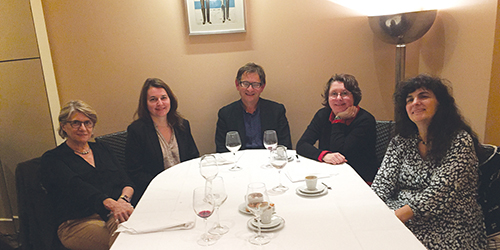
The jury after the meeting. From left to right: Martine Janvier, Martine Brilleaud, Bertrand Hauchecorne, Nathalie Juste and Leila Schneps.
First things first: let us begin with the Tangente Book Prize. As every year, our readers eagerly awaited the jury's verdict. Now firmly established as a leading award, the prize showcases literary or cultural books that foster an appreciation of mathematics and are accessible to a broad readership. Publishers keen to reach a wider audience, and of course the nominated authors, hoped to secure either the top honor or, failing that, a special mention.
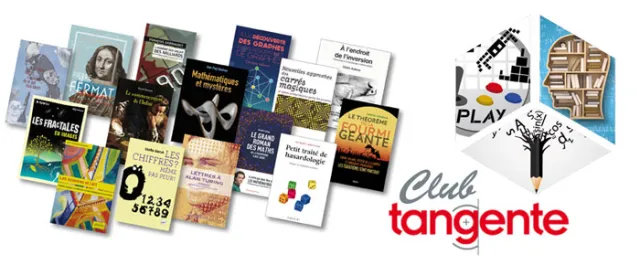
Before the jury deliberates, however, online readers vote to choose the nominees from books published in the previous 18 months that meet the Prize rules and have been reviewed in Tangente. Five outstanding books were selected in this way for the 2017 prize (see the full list of 15 books considered for the 2017 prize in issue 177 of Tangente, page 7). Three are essays that invite readers to gain a deeper understanding of mathematics and reflect their authors' passion for the subject. The fourth is a detective novel in which mathematicians are targeted by killers. The fifth is a collaborative historical work honoring Pierre de Fermat.
Chaired by Bertrand Hauchecorne, the jury is reconstituted each year and includes one or more of the previous year's winners or nominees. As befits any literary prize worthy of the name, it met over an excellent meal before delivering its verdict.
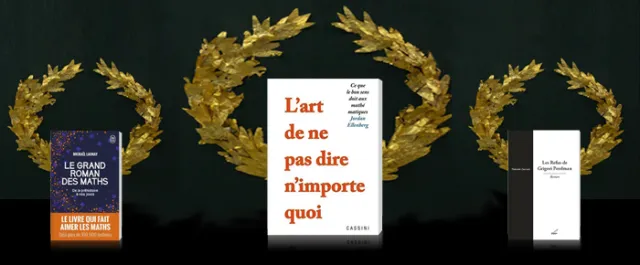
The Tangente Book Prize goes to Mickaël Launay for Le grand roman des maths (Flammarion).
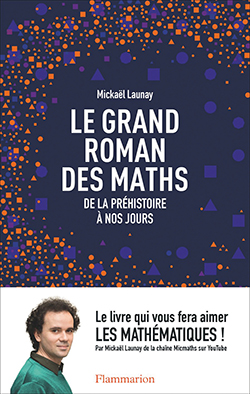
In this book (see our review), the author goes back to prehistoric times to explain how the earliest notions of arithmetic and geometry arose. He takes us on a journey through time and space to explore the emergence of mathematical ideas. With charm and enthusiasm, he guides us through the development of mathematics. In his final chapter, entitled Maths à venir, he shows us that this story will never be finished.
The jury also awarded special mentions to the following two books:
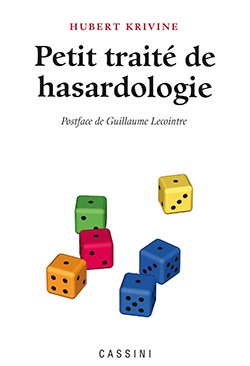

Le petit traité d'hasardologie by Hubert Krivine (Éditions Cassini) offers a simple yet precise overview of the issues surrounding probability (see our review); drawing on numerous examples from everyday life and history, it warns readers of the many pitfalls involved. Written in a highly accessible style, the book is peppered with humorous cartoons.
Pierre de Fermat l'énigmatique (Éditions Midi Pyrénéennes): edited by Marielle Mouranche, this book brings together scholars from Toulouse—mathematicians, legal experts and historians, nine authors in all—who immerse us in Fermat's world and reveal the connection between his life as a lawyer and his extraordinary mathematical discoveries (see our review). The outstanding quality of the book's illustrations is also worth noting.
But the other two nominated books were also worthy contenders. Jean-Paul Delahaye's Maths et mystères (Éditions Belin) caught the jury's attention with the originality of its content (see our review). Its author had already won the Tangente Prize in 2014 with Inventions mathématiques. François Darnaudet's L'homme qui valait des milliards – Le hacker de Bordeaux (Éditions Wartberg; see our review), meanwhile, was a resounding favorite with young readers, who awarded it the Tangente High School Students' Prize (see below).
The 2017 Tangente High School Students' Prize goes to François Darnaudet
===============================================================================================================================================================================================
Because of the school calendar, the 2017 Tangente High School Students' Prize was decided the previous June by more than 200 students from 20 high schools across France, even though it was presented to the winners at the same time as the other awards.
The idea is simple: ten books selected by the editors of Tangente are sent by their publishers to ten participating schools (while the others purchase them), providing an original way to expand the collections of their school libraries. The books must have some connection with mathematics, but may be novels, personal accounts, detective stories, popular mathematics books, comics or biographies.
Each high school commits to involving motivated students, who read at least six of the books during the year and rank them in order of preference. Combining all their rankings determines which book wins the Tangente High School Students' Prize.
The 2017 winner is François Darnaudet for his novel L'homme qui valait des milliards (Wartberg).
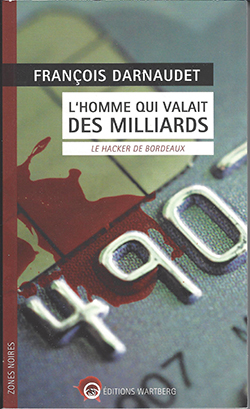
Were the students won over by the story of a manhunt set against a backdrop of conspiracy and the puzzle of the millennium, or by the mathematics teacher—a disillusioned antihero who drowns his resentment of the French education system in alcohol, rock music and sex (as befits any self-respecting noir thriller)? It is worth noting that online voters also selected this book as one of the five nominees for the 2017 Tangente Book Prize (see above).
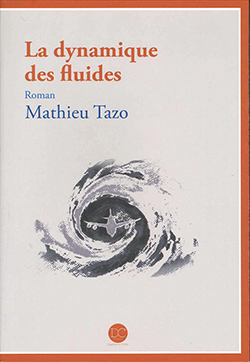
A second novel, Mathieu Tazo's La mécanique des fluides (Daphnis et Chloé; see our review), also caught the students' attention. The mathematical elements featured in this book are the Navier–Stokes equations and the fascination they inspire.
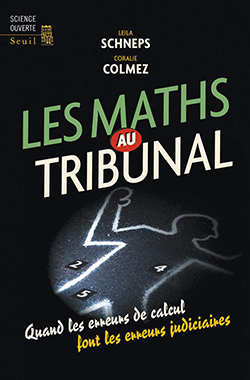
But young readers are also interested in real events and the sometimes tragic consequences of misinterpreting mathematics—in this case, statistics and probability—in the justice system. Les maths au tribunal by Coralie Colmez and Leila Schneps (Le Seuil) therefore received a special mention. This book (see our review) will be familiar to Tangente readers. It had already received a special mention for the 2016 Tangente Book Prize.
=
Roger Mansuy wins the Tangente Best Article Prize
============================================================================================================================================================================================
Created in 2014, the Tangente Best Article Prize recognizes a popular mathematics article written by a talented amateur who is not a professional journalist. The jury had to choose among numerous entries, all of them highly engaging. But a choice had to be made. The jury, which also changes each year, awarded the prize to Roger Mansuy, a mathematics teacher at the Lycée Louis-le-Grand. Although not a professional journalist, he is a familiar figure in the mathematical press, having served as editor-in-chief of the journal Quadrature.
His article, "Des traits et des maths," explores properties of finite graphs related to a conjecture made in 1946 by the Hungarian mathematician Paul Erdős. The central question is this: given n points (placed however we wish), what is the maximum number of equal-length line segments that can join them? The question is very approachable and can already be explored by hand by drawing graphs with three, four or five points. Yet the problems that emerge are far from easy to solve...
The jury appreciated the article's clarity and pedagogical quality, and enjoyed discovering—or rediscovering—these experiments with finite graphs, which are almost like a game... one that Tangente readers will also be able to try, since the article will be published in our next issue (one of the rewards). It will also appear on the CultureMath website, a partner of the prize.
A special mention was also awarded to Léo Gerville-Réache, who won the prize last year, for his article entitled "Comment se comporter rationnellement face au risque?", whose breadth greatly impressed the jury.
**The Bernard Novelli Prize goes to Alexandre Variengien**
========================================================================================================================================
Now in its fifth edition, the Bernard Novelli Prize rewards computing projects by high school students involving mathematical games. The competition is supported by leading names in the field: the SIF (Société informatique de France), CASIO calculators, Magma Mobile video games and the magazine Programmez !
The jury examined and assessed the technical merits of the candidates' mathematical or logic game projects involving artificial intelligence. The winner is Alexandre Varengien for his game "Dominos évolutifs," created using the Python programming language and its Tkinter module (a free Python library for creating graphical user interfaces). The game is described in a sidebar by Thierry Garcia, the SIF representative on the jury.
In all, nine awards were presented. All the winners receive works of mathematical art created by artists, several of whom have won the Tangente Osc'Art in previous years: Jérémie Brunet, Denise Pranville, Patrice Jeener, Scowcza and Sellig Zed.
But organizing events like these requires not only financial resources, provided by our partners—chiefly Magma Mobile and Casio, whom the entire team would like to thank—but also a great deal of time. Any readers interested in volunteering through the Club Tangente association are more than welcome. Do join and offer to help with whichever awards appeal to you most by sending us an email.