Remember: a year ago, the Tangente awards ceremony at the Palais du Luxembourg immediately followed our magazine's 30th-anniversary celebrations at the Musée des Arts et Métiers, which opened to the public free of charge for the occasion. Both events were an extraordinary success: remarkably, 3,000 people came to the museum to celebrate our anniversary.
More than enough reason to do it again! The Club Tangente team got back to work and decided to combine the two events this year. A day was therefore scheduled at the museum for Sunday, 2 December, exploring the relationship between mathematics, literature, computing and games—a relationship reflected in the various awards presented at the end of the day.
Alongside the museum's existing exhibitions—including "Sous la surface, les maths" (Beneath the Surface: Mathematics), described in Tangente 184 and discussed throughout the day by its curator, Olivier Druet, and two guides—the program featured talks, book signings, game workshops, mathematical stories for children and a teachers' gathering… It concluded with the Tangente Awards ceremony, hosted by journalist Mathieu Vidard, whose winners are presented in this article.
First things first! Let's begin with the longest-established award.
2018 Tangente book prize
---------------------------
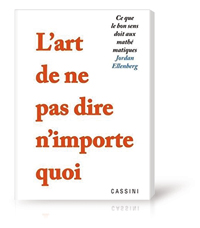
How Not to Be Wrong, by Jordan Ellenberg.
The Tangente Book Prize and Tangente High School Students' Prize showcase literature connected with mathematics by honoring cultural works that foster an enthusiasm for mathematics and are accessible to a broad readership. Most of the books recognized in recent years can be found on the inside back cover of this issue.
For the Book Prize, our online readers voted to shortlist works published within the previous eighteen months that had been reviewed in Tangente. They chose well: according to the jury members, they had the task of deciding among five excellent books.
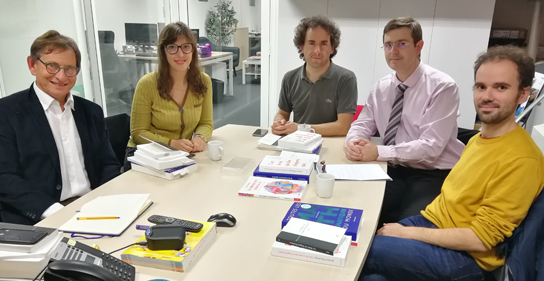
The Tangente Prize jury:
Bertrand Hauchecorne, Manon Gissot, Benoît Rittaud, Roger Mansuy, Mickaël Launay.
They included two fictionalized accounts of mathematicians, two books presenting various diversions or paradoxes drawn from classic games or everyday situations, and a final book surveying mathematics and its applications. Three of the five shortlisted books were presented by their authors in the lecture hall during the Tangente event, after which the authors took part in a book signing.
This was only natural for Jean-Paul Delahaye, already a Tangente Prize winner in 2014, whose shortlisted book was entitled Les Mathématiciens se plient au jeu (Mathematicians Play Along; Belin, 2017). Another previous Tangente Prize winner was Hervé Lehning, the 2011 winner, who was competing with Toutes les mathématiques du monde (All the Mathematics in the World; Flammarion, 2017). The third nominated book whose authors gave a presentation was Je suis… Sophie Germain (I Am… Sophie Germain), by Anne Boyé and Christine Charretton, published by Éditions Jacques André.
The Tangente Prize went to How Not to Be Wrong, by Jordan Ellenberg, translated into French by Françoise Bouillot and published by Éditions Cassini. This American mathematician is a regular writer of science columns, particularly for the New York Times and the Washington Post.
The book is certainly substantial—nearly five hundred pages—but its light style makes it enjoyable reading for novice and specialist alike. It tackles aspects of everyday life ranging from the serious to the anecdotal. Far from being a textbook, it is not at all professorial in tone, but reads more like a conversation. Ellenberg is methodologically cautious and uses mathematics as a tool for understanding society. French readers will discover the author's acerbic view of American society and some of its shortcomings. They will also enjoy such original chapter titles as "Public Opinion Does Not Exist." Perhaps this book will help them weigh their arguments more carefully and stop talking nonsense. That, at any rate, is its aim.
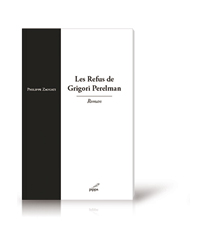
The jury also gave a special mention to Les Refus de Grigori Perelman (Grigori Perelman's Refusals), by Philippe Zaouati, published by Éditions Pippa. This short, accessible book recounts the meeting between the Russian researcher and John Ball, president of the International Mathematical Union, who was attempting to persuade Perelman to accept the 2006 Fields Medal. As Fabien Aoustin writes in the review devoted to it in Tangente 183, the encounter between the two men is by turns tense, impassioned and companionable… The author imagines their conversations as they walk across the bridges and through the streets of Peter the Great's legendary city, Saint Petersburg.
2018 Tangente high school students' prize
------------------------------
Le Grand Roman des maths (The Great Story of Mathematics), by Mickaël Launay.
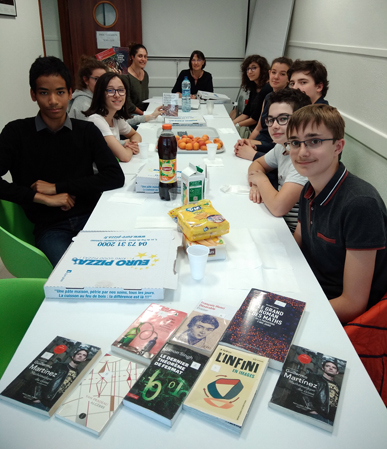
The students of
Sainte-Thècle High School in Chamalières
(Puy-de-Dôme)
at their traditional
literary picnic.
The Tangente High School Students' Prize is awarded by students from some twenty high schools, who read the ten shortlisted books throughout the school year and then vote for their favorite.
The 2018 winner had therefore been known since the previous June: Mickaël Launay, for his book Le Grand Roman des maths (Flammarion, 2016; see the review in Tangente 174). The same book had already won him the Tangente Book Prize in 2017, showing that he knows how to captivate a very broad audience! This is precisely what Launay does every day on Micmaths, his mathematics popularization channel, which has made him a well-known YouTuber.
We asked students from Jeanne-d'Arc High School in Bayeux (Calvados) for their thoughts: "We often hear about calculations, the latest research and the latest discoveries, but we do not really know how we reached this point. Here is a clear and interesting book that shows us how mathematics has developed since the dawn of time."
*
*
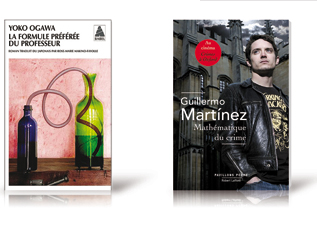
Two special mentions were also awarded. The Housekeeper and the Professor (Actes Sud, 2008), by Japanese writer Yoko Ogawa, tells of the bonds of friendship that form between a former mathematician whose memory, following an accident, is limited to ninety minutes, and his housekeeper. First published in Japan in 2003, the novel was adapted for the screen in 2006 by director Takashi Koizumi. Unfortunately, the film was never released in France. "This novel has endearing characters. It offers an original perspective on mathematics and teaches us things about everyday life. It prompts us to reflect on the world around us," commented the students of Georges-Clémenceau High School in Nantes (Loire-Atlantique).
Mathématiques du crime (Mathematics of Crime; Robert Laffont, 2008), by Argentine writer and mathematician Guillermo Martinez (see the review in Tangente 183), is a thriller that weaves logic, the work of Kurt Gödel and Ludwig Wittgenstein, the proof of Fermat's Last Theorem and even Pythagorean sects into a police investigation, keeping readers in suspense until the final resolution. The book was adapted for the screen by Álex de la Iglesia under the title The Oxford Murders.
Best article prize: one prize and one special mention
-------------------------------------------------
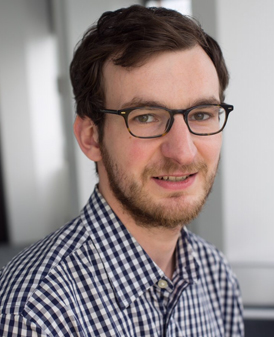
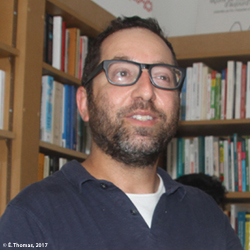
The Best Article Prize recognizes a proposed article "in the style of Tangente," in its subject matter—mathematical culture for a broad readership—its style—lively and not academic—and its length—between two and four pages. The 2018 prize went to Clément Lelièvre (pictured above) for The Mind-Bending Properties of Infinity, which focuses particularly on the divergent harmonic series (Σ 1 /n) and the corresponding alternating series (Σ (-1) *n /n*), which does converge. Remarkably, by cleverly rearranging the terms of the latter, its sum can be made to reach any prescribed number!
Daniel Bouix received a special mention for his article How Many Colors Are Needed to Color the Tiles of a Plane? Remaining within the theme that led to the four-color theorem, the author takes the opposite approach: which plane tilings can be colored with three colors? He presents several avenues for investigation, along with a method that extends a local property to the entire plane. Readers of every level will want to embark on the investigation themselves…
The public will soon be able to read these articles in the pages of Tangente, as well as on the websites of the prize's partners, CultureMath (**culturemath.ens.fr) and APMEP (apmep.fr**).
Novelli prize awarded to two young women
---------------------------------------------
The Bernard Novelli Prize, which recognizes a computer game program based on mathematics, is supported by Casio and the SIF (Société informatique de France). For the first time, it was awarded to a team of two girls, Géraldine Faure and Julie Callendret—with illustrations by Julie's sister, Marion Callendret—for the "Hobbit game" (see FOCUS, "Novelli Prize: The Hobbit").
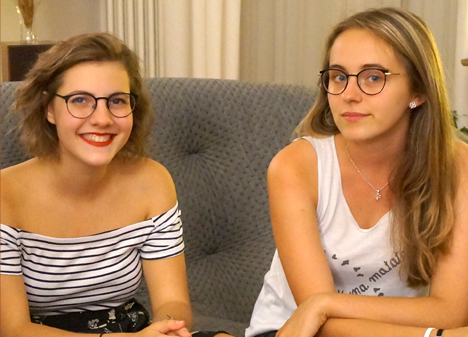
The game's Python program consists of 693 lines of well-commented code. It has a clean, appealing design, but above all a mathematical foundation: players use mental arithmetic to find the best solution, while the creators used Pascal's triangle and binomial coefficients to calculate the best paths—the aim of the game—starting from the last square and then working recursively back to the first.
The Novelli Prize is reaching a new milestone this year, as schools can now enter and have their students take part. All they need to do is send an email to [email protected] before 15 January 2019.
The game's theme and rules, as well as the programming language, may then be chosen freely by the organizing teachers.
After mentoring the projects, the teachers will select between one and three entries to represent their school at the national jury meeting.
The first ten high schools to register for the 2018–2019 school year and choose Python will each receive a CASIO Graph 90 + E calculator free of charge.
Naturally, young people can still enter as independent candidates, either individually or in groups, by preregistering on the website:
www.tropheestangente.com.
Affaire de logique competition
---------------------------
A competition was organized last year to celebrate the thousandth weekly "Affaire de logique" column in Le Monde. Following its success, the organizers decided to run it again and include it in the Tangente Awards.
This time, only eight problems were set, compared with twenty-five last year. Two categories were created, "amateurs" and "experts," with a prize for each. But you are simply too good! Twenty-five contestants tied for first scored full marks in the "experts" category, and four in the "amateurs" category.
The self-referential tiebreaker asked entrants to name the number chosen least often by the "amateurs"—from among the integers 1 to 20—and the number chosen least often by the "experts"—from among the integers 1 to 30. As luck would have it! Here are the respective vote totals for each number, with the amateurs' and experts' votes combined.
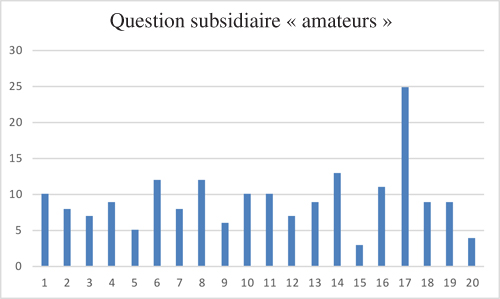
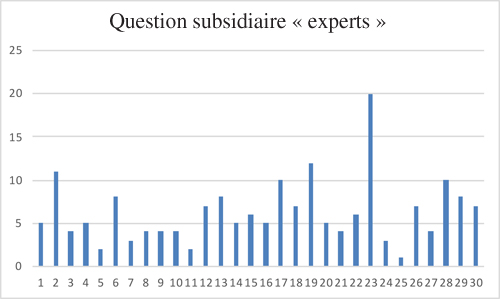
Despite this two-part question, two "experts" still achieved the maximum score. Two prizes were therefore awarded, to Pierre Parodi and Christophe Luppens. Frédéric Gloannec won first prize in the "amateurs" category. Works of mathematical art were presented as prizes for each award: fractal art by Jérémie Brunet, vector art by Scowcza, engravings of 3D surfaces by Patrice Jeener, and photographs by Denise Demaret-Pranville and Claudine Cochet.