Dear readers, many of you, passionate about mathematics and literature, share the Tangente editorial team's belief that mathematics and literature are made for each other and should not be kept apart, despite what we unfortunately hear all too often. Are you also convinced that a good mathematics book can be informative while remaining accessible to a wide audience?
You are right: mathematics is meant to be shared. Like art, it is an essential part of what makes us human, shaping our choices, how we analyze the world around us, and our appreciation of beauty and harmony.
-
Vote for the 2017 Tangente Book Prize
-----------------------------------------
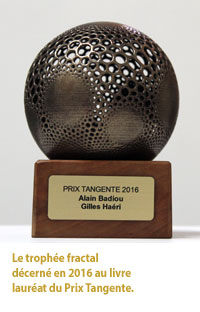
The Tangente Book Prize was created to share this view as widely as possible and put it into practice. Each year, it honors a work of mathematical literature that "makes readers want to learn more about the subject".
Of the thousands of books published each year, some focus on an aspect of mathematics. They are reviewed in Tangente, and the reviews are also available free online. As is now traditional, many of these reviews appear in the summer issue you are holding. A link to the reviews will also be posted on the Facebook page of *Tangente or its *Twitter **account, which you are all invited to follow.
The editorial team identifies books whose content meets the eligibility criteria for the Tangente Book Prize, and readers vote on them in the July issue (see the rules online). For the 2017 Tangente Book Prize, the box features 15 books published between January 1, 2016 and June 30, 2017. They range from essays and novels to biographies, and cover a variety of subjects, but all approach mathematics from a cultural perspective.
First, you—our loyal mathematical adventurers—will vote online for your favorite book. You do not need to have read them all: the aim is to help a book you value stand out. Nor is voting restricted to subscribers; simply register on the website to take part. You have until September 30 to vote (make the most of the summer to read!), and you may change your vote right up to the deadline.
Next, a jury made up of prominent figures and previous winners will meet to choose the winner from the five books shortlisted by online voters.
Finally, the prizes—works of mathematical art—will be presented to the winners at the awards ceremony, to be held on December 4, 2017, at the Palais du Luxembourg.
This year, on the day before the ceremony, you can meet the shortlisted authors at the celebration marking Tangente's 30th anniversary at the Musée des arts et métiers and, if you wish, have them sign your copy.
-
An initiative to get high school students reading
------------------------------------------
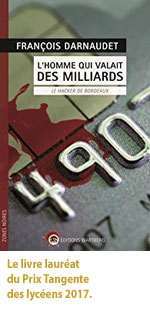
But the Tangente Book Prize is only one of the awards presented by Club Tangente. For the past two years, it has had a companion: the Tangente High School Students' Prize. Organized somewhat differently, this prize makes no secret of its aim to bring mathematical literature into high-school resource centers. Nearly 200 students from 16 high schools across France took part in the 2017 edition. How does it work? At least ten students at each school read the ten selected books over the course of the year and rank them. Combining all these rankings produces a national winner. The prize also provides a framework for a range of activities centered on mathematical literature. Reading clubs, radio reviews, meetings with authors and interdisciplinary projects combining mathematics and French have all sprung up. This initiative offers students who think of themselves as "literary" a different way to discover mathematics, while encouraging self-described "maths people" to read. In every case, everyone benefits from sharing ideas and debating together.
Because of the school calendar, the winners of the 2017 Tangente High School Students' Prize have already been announced. Of the ten books selected for 2017, the students chose François Darnaudet's novel L'homme qui valait des milliard (Wartberg), followed by another novel, Mathieu Tazo's La dynamique des fluides (Daphnis et Chloé), and Coralie Colmez and Leila Schneps's book Les maths au tribunal. This essay on the disastrous consequences of errors in reasoning during legal proceedings had already received a special mention in the 2016 Tangente Book Prize. The authors will nevertheless have to wait until the awards ceremony to receive their prizes.
-
Two competitions you can still enter
----------------------------------------------------
The winners of the Best Article Prize will also be honored at the ceremony. Open to anyone who would like to try their hand at writing about mathematics for a general audience, the prize aims to showcase new talent in mathematical writing. Winners will have the pleasure of seeing their work published in Tangente. For some, this marks the beginning of a new career: Christian Laforest, winner of the 2015 prize, has just published his first book, which is competing for the Tangente Book Prize. Fabien Aoustin, the 2014 winner, has been a regular contributor to your favorite magazine for the past two years.
Finally, last but not least, the Bernard Novelli Prize, will honor a young computer-game creator. There is something new this year: the competition is open to students up to the third year of a bachelor's degree. Entrants have until September 30 to submit a proposal describing the game they have designed. The game must relate to mathematics, whether through its rules or its design. One of the winner's prizes is the opportunity to have the game developed by professionals and made available on download platforms. The Novelli Prize is organized in partnership with CASIO, the calculator manufacturer familiar to everyone; Magma Mobile, a mobile-game publisher; the SIF (Société informatique de France); and the magazine Programmez!
If you are interested in entering any of the awards presented by Club Tangente, you will find full details of the various competitions—the rules, entry procedures and dates—on the Tangente Awards website, along with photographs of previous award ceremonies.