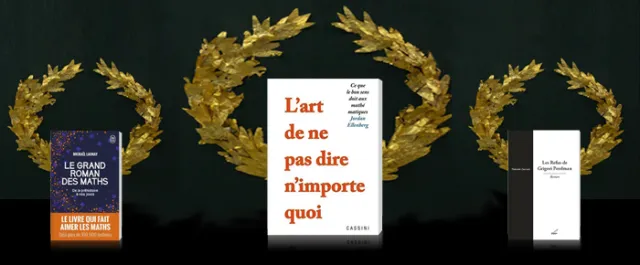
Organized each year by the Club Tangente with support from our magazine and several partners, the Tangente Trophies have become unmissable events for mathematics enthusiasts, authors, publishers and everyone involved in our fascinating discipline.
We thank everyone who supports us in this initiative, which requires both time and resources, and we encourage other partners to come forward. Our thanks also go to everyone involved in organizing the various competitions, serving on the juries or creating the artistic trophies awarded to the winners and those receiving commendations. Meet the 2020 winners. Mathematics teachers turned out in force this year.
Tangente Book Prize: Very Math Trip
-----------------------------------------
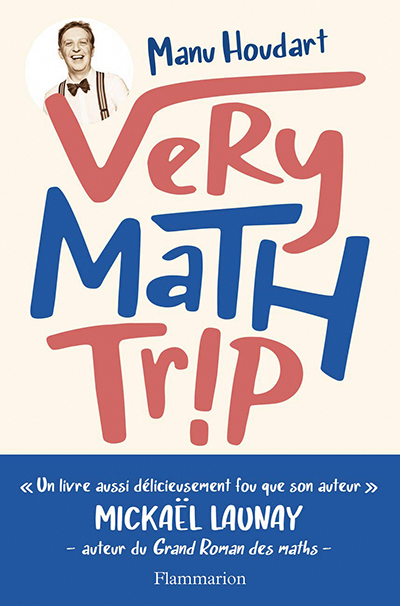
The Tangente Book Prize is the flagship award among the Trophies. It was awarded to Very Math Trip, a book by Manu Houdard published by Éditions Flammarion in 2019. You can read the review published in Tangente 192 on the **tangente-mag.com** website.
In 2003, alongside his teaching, Manu Houdard, a Belgian mathematics teacher who holds the agrégation, began founding associations: first to support struggling students, then to popularize mathematics, culminating in the Maison des Maths de Quaregnon in 2015. In 2011, he made the difficult decision to put his teaching career on hold and devote himself to this mission. In 2017, after receiving the Walloon of the Year Award, he left the association to put his storytelling talent to work in the one math show he created under the title "Very Math Trip." His book is intended as an extension of the show\*.

The jury admired the book's narrative dimension: it reads like a novel. The author takes readers by the hand with genuine teaching flair, buoyed by his enthusiasm and humor. The jury also highlighted how the anecdotes work on several levels—both for newcomers and for specialists, who can appreciate an unexpected angle. Besides the famous "Wow" effect found in every chapter, the book produces a second, educational kind of "Wow": concepts are approached in an illuminating and original way.
Tangente: Is there anything you would like to add about your background?
Manu Houdard:"You will of course have gathered that mathematics plays a very large part in my life. So does literature! I cannot walk into a bookshop without leaving with several books: biographies—whatever the field—detective novels and, naturally… mathematics. I do, in fact, love the French language."
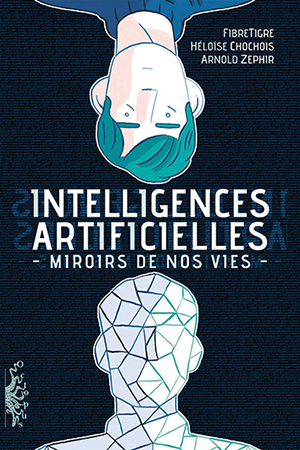
The jury awarded a commendation to the graphic novel Intelligences Artificielles, published by Delcourt, co-written by Arnold Zéphir and FibreTigre and illustrated by Héloïse Chochois. On the **tangente-mag.com** website, you can read the review published in Tangente 195.
The book tackles a social issue head-on: public perceptions of AI. It presents the ethical questions raised by the use of this new tool, including anthropomorphism, sexism and changes in our relationship with work. At regular pauses in the narrative, it makes a concerted effort to explain the mathematical processes involved in how AI works. The manga-influenced artwork is a major asset in making the subject accessible.
2020 Tangente Prize for Best Article
A prize and a commendation for two teachers
-----------------------------------------------------------------------------------
Organized in partnership with the CultureMath website and APMEP, the Tangente Prize for Best Article invites submissions of previously unpublished articles on a mathematical topic or on the role mathematics plays in another field. Like the articles in Tangente, they must appeal to a broad audience. The lucky winner will also have the pleasure of seeing their work published by the partner media: in Tangente, of course, but also in Au Fil des Maths (APMEP's newsletter) and on the CultureMath website. Some previous winners have subsequently become regular contributors to our magazine.
Among the many candidates bold enough to embark on the adventure, the 2020 jury chose to honor Frédéric André, a mathematics teacher at the Lycée de La Salle in Alès (Gard), for his article entitled Homo Academicus dans son labyrinthe. This beautifully written piece draws inspiration from a short story, le Stratagème, taken from Jorge Luis Borges's book le Livre de sable. It features three characters, the first of whom must recruit one of the other two. The choice calls for logical and paradoxical reasoning—a logical modeling of literature that delighted the jury.
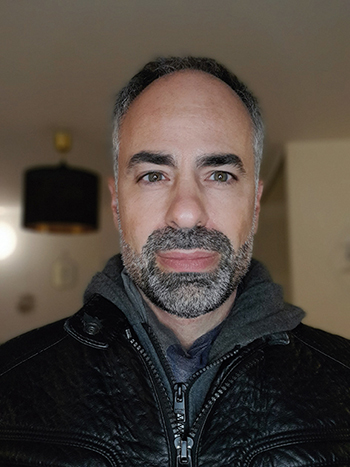
Frédéric André:"I recently translated Terence Tao's book l’Art de résoudre les problèmes de mathématiques (published by Cassini). I obviously enjoy literature, and my decision to write a short article about a very accessible text by Borges was prompted by his particularly stimulating use of paradoxes. I wanted to offer an interpretation involving a series of brief arguments by contradiction. As so often happens in mathematics, combining several simple arguments produces a far less obvious, even counterintuitive, result. That seems to have been the case here."
A commendation went to Aurélie Alexandre, also a teacher—at Collège Marcel-Pagnol in Sérignan, Hérault—for her article Algorithme d’Euclide et cætera. Starting from the Greek scholar's text, translated by Denis Henrion in the delightful style of the Renaissance, the author takes us through the centuries to modern applications of this number-theoretic property. Her interview, available online at **tangente-mag.com**, is published in issue 55 of Tangente Éducation.
Both of this year's award recipients are teachers. Their lessons must be wonderfully lively—we envy their students!
Two commendations in the 2020 Novelli Prize
----------------------------------


Supported by CASIO, the SIF (Société informatique de France) and *Programmez !* magazine, the Novelli Prize rewards mathematical game programs created each year by middle- or high-school students, either independently or as part of their school curriculum. The Covid-19 pandemic severely disrupted the prize. The year had promised to be exceptional, given the large number of entries received, most of them submitted with the involvement of middle and high schools. Unfortunately, completing a project requires a great deal of collaborative work, as well as students having in-person access to their teachers to receive the help and advice they need.
Nevertheless, among the completed projects submitted, the jury decided to award special commendations to two highly engaging programs that their young creators managed to finish despite the circumstances. Learn more about them in the box below.
Winners traditionally receive the diploma created by the artist Sellig Zed, along with a subscription to Tangente. Impressed by the work put in by the candidates, Progammez!, the magazine for developers, will publish an article presenting their projects and is giving each commendation recipient a PDF subscription and a "Programmez MicroPython Card." This board can be used to build electronic devices controlled with the Python language. It will undoubtedly open up even more possibilities for our young developers.
An interview with the creators of SneakyMath
-------------------------------------
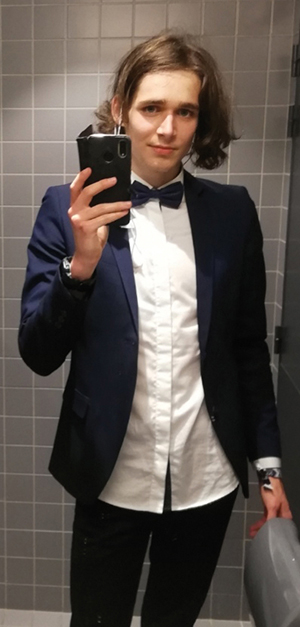
Natan Doubez.
Romain Benoît (18) and Natan Doubez (17) created the SneakyMath program together. We asked them to introduce themselves.
Natan kept it brief, telling us he was "snowed under with work": "As a young student in classes préparatoires (post-secondary preparatory classes) at Sainte-Geneviève, I am always eager to learn and to teach others. Passionate about both dance and science, I try to enter every competition I can so that I can discover new ways of approaching the world."
You will find his photograph above, but not Romain's: he does not want a teenage picture of himself to appear years from now among the top Google Images search results (!)
Romain:"Last year, we were two high-school students in the same class. Together, we entered numerous competitions (Algoréa, Al-Kindi, the Mathematical Olympiads in 11th grade, the Concours général in our final year and the regional mathematics rally). Such competitions are a good way to motivate oneself to tackle more ambitious projects. Natan, a keen mathematician, went particularly far, notably entering competitions organized by Animath. We acquired our shared foundation in algorithms through the ICN elective in tenth grade (French seconde), and especially through the France-IOI website.
Our paths have since diverged. This year, I joined INSA Lyon's integrated preparatory program with the aim of becoming a computer engineer. My passions—although I now have far less time to devote to them—revolve around games (I am an avid Minecraft player) and, of course, computing.
Ever since I discovered programming with Scratch in middle school, I have been writing small games and algorithms, first to run on our Casio calculators—my version of Snake kept Natan and me well occupied during some of the longer lessons—and later on PCs. At first, I programmed exclusively in Python and tried to deepen my understanding of it, but I can now see its limitations and am experimenting with Java and game engines to open up more possibilities."
Tangente: What did the Novelli Prize mean to you?
Romain:"The Novelli Prize was a good opportunity for us to put what we had learned and our ideas into practice. The game's original concept was to make mental arithmetic more fun, hence this real-time game in which decisions must be made on the fly. We went through several versions and prototypes before finally converging on mechanics reminiscent of Snake. For me, Snake is a model: no levels, complicated rules or controls, just one mechanic and a great deal of fun. In the end, the game became relatively complex, but we did everything we could to make it clearer so that everyone could play it and, we hope, have fun.
I greatly enjoyed creating this project, and the project culminated in the launch of a dedicated webpage where I could share it\\. A link would allow Tangente readers to try it."
\* A new version of the show is scheduled for 2021 (subject to confirmation): January 5 in Carquefou (Loire-Atlantique), January 19 in Aulnay-sous-Bois (Seine-Saint-Denis), April 16 in Decazeville (Aveyron) and April 29 in Strasbourg (Bas-Rhin).
The address is given in the box.