The Bernard Novelli Prize goes to Romain Guetta
---------------------------------------
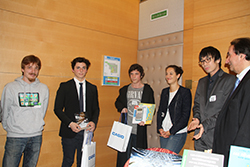
Romain Guetta, 18, is the winner of the Bernard Novelli Prize, the competition that, with the support of Casio and Magma Mobile, honors a computing project centered on games and mathematics every year. Born in Grenoble, where he still lives, he is currently enrolled in a PCSI "math sup" class at Lycée Champollion, having earned his S-SVT baccalauréat in 2015 with highest honors. He acknowledges that it was in tenth grade that he first felt the "desire to know," thanks to one of his teachers, Mr. Durand, who introduced him to science and "made him understand that he was capable of far more than he imagined." Drawn to new technologies and to scientific and technical advances, he then naturally turned his interest toward computing, but it was only in his final year, thanks to the ISN specialism, that he began studying algorithmics, a subject he finds fascinating. He is keen to thank his final-year maths and ISN teacher, Mrs. Rodary, who "taught him the rigor and the beauty of mathematics."For this competition, he spent two months programming Elmer's Game. The game, which can be played by two people or solo against the computer, involves solving a multicolored puzzle in the shortest possible time, using a rule similar to that of the famous sliding puzzle to move the tiles. According to the judges, the game is "gripping" – you never tire of it – and the algorithm used is sophisticated (with sorting and recursion). The program, written in Python, runs to 1,200 lines of code.
-
The 2014 winning project soon available on smartphone
----------------------------------------------------------------------
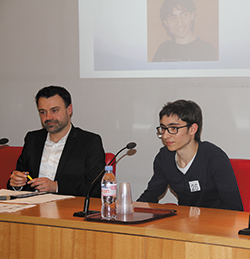
The winning game of the 2014 Novelli Prize was also the work of a high-school student, Mathieu Roget. The principle behind his game, originally titled "Des + et des –" ("Pluses and Minuses"), rests on the rule of signs for multiplication. In a square grid that can hold + or – symbols, the player rotates the symbols left or right, with the blocks falling under gravity. When two – blocks collide, they turn into + blocks, and when a + block hits the ground, it disappears. The goal is to clear the grid, given that + and – blocks appear randomly with every rotation on the grid. In the "mobile app" version, it is planets, marked with + and – signs, that collide with each other, hence the game's new name, "Planète des signes" ("Planet of Signs"). The app will soon be available on most platforms. It will be downloadable free of charge from the main mobile app stores.
-
The Best Article Prize goes to Christian Laforest
------------------------------------------------
The Best Article Prize, supported by the APMEP (Association des professeurs de mathématiques de l'enseignement public), is intended to reward a non-professional author "who has presented, in an unpublished article (written less than a year ago and never published in a professional publication), a subject related to mathematics or to the involvement of mathematics in another field, in a form appealing to a broad audience."
It was awarded to Christian Laforest, a teacher at the ISIMA computer engineering school and a professor at Université Blaise Pascal (Clermont-Ferrand), while an honorable mention was given to Fabien Aoustin, a teacher at Lycée Condorcet in Saint-Quentin (Aisne).
These winners are no strangers to the prize: last year, Fabien Aoustin won it and Christian Laforest received a mention!