The concepts of midpoint and center of gravity were already in use in antiquity, inspired by problems in elementary physics. In his treatise On the Equilibrium of Planes, Archimedes introduced the concept of center of gravity and studied the properties of the lever. He is credited with saying: "Give me a fulcrum and I will lift the Earth." At the time, no distinction was made between affine and Euclidean concepts—that is, those involving distances and angles.
During the Renaissance, the study of perspective, followed by the work of Girard Desargues (1591–1661), drew attention to properties that are preserved without reference to these concepts.
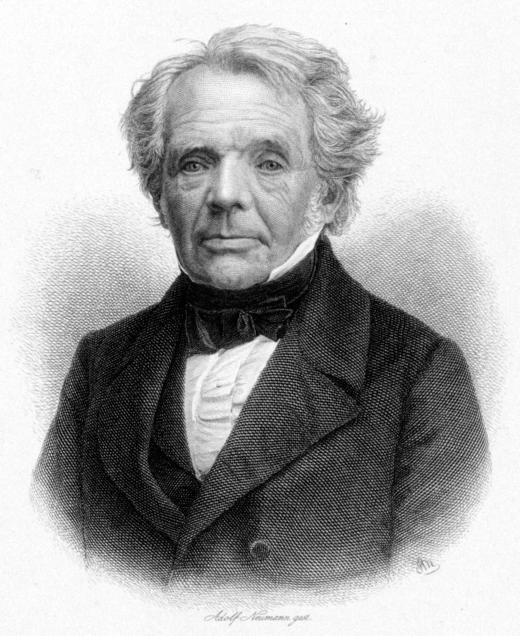
In the early 19th century, a new approach to geometry, known as projective geometry, emerged (see Tangente 162, 2015). Many mathematicians contributed to its development, but Möbius—best known for studying the one-sided surface that bears his name—gave the first precise mathematical formulation of the barycenter in his book Der barycentrische Calcül, published in 1827.