Representing a planetary system
----------------------------------
In mathematics, a weighted system is a set of elements, each assigned a certain weight. When these elements are numbers, they have an associated weighted mean.
For a system {(x1, p1), (x2, p2 )… (*xn, pn )}, the weighted mean mp or barycenter is (see the article An affine concept inspired by physics*):
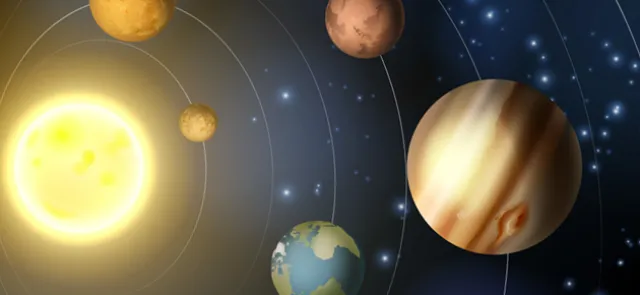
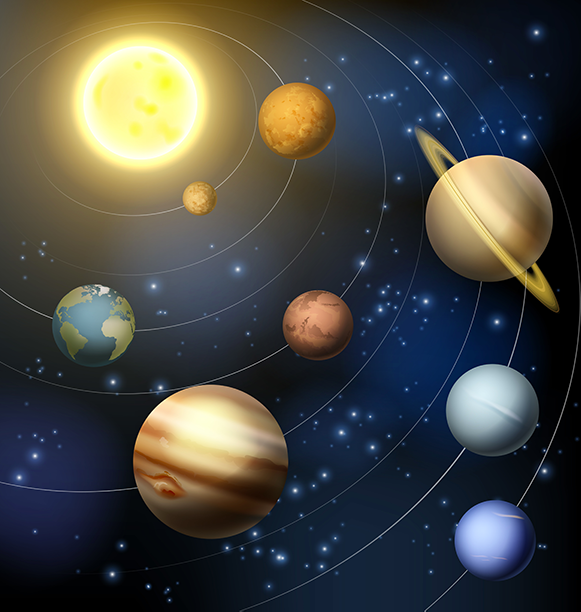
In astronomy, a planetary system can be viewed as a system of distances—weighted by the masses (the *pi )—between the star at its center and the various bodies making up the system (the xi ). The distance from the star to itself is zero ( x*1 = 0). In the case of the solar system and our planet, the Sun's mass is 333,000 times that of Earth. Their barycenter is therefore "very close" to the center of the star that lights our world.
It is generally said, somewhat imprecisely, that "Earth revolves around the Sun." In fact, a planet and its system's central star move not relative to the star's center, but relative to the barycenter of the weighted system formed by the star and the planet. For Earth, the difference is negligible. But this is not true of massive Jupiter, whose mass exceeds 300 Earth masses: the resulting weighted system has a barycenter more than 45,000 km above the Sun's surface, and both giants orbit it.
The Earth–Moon pair
--------------------
What about the Earth–Moon pair? Earth's mass is of the order of 6 × 1024 kg. The Moon's mass is only 1.23% of this.
The associated weighted system can therefore be represented as {(0, 1) (384,000, 0.0123)}, taking the Earth–Moon distance to be 384,000 km while bearing in mind that it varies.
Given the precision of these data, the system's barycenter is located at:
that is, approximately 4,700 km from Earth's center.
Earth's radius, which also varies, is of the order of 6,380 km. Thus, although the pair's barycenter lies relatively far from Earth's center, it is still inside the Earth, giving rise to a "wobble" in the relative motion of Earth and the Moon.
The Pluto system
--------------------
The Pluto system consists of six gravitationally bound objects orbiting within a certain distance of the largest among them. Discovered in 1930, this object was named Pluto and was initially considered the ninth planet in the solar system. Other objects of comparable mass were gradually discovered, leading the International Astronomical Union to reconsider Pluto's status. It is now classified as a dwarf planet, like other trans-Neptunian objects.
Consider the pair formed by Pluto and its largest moon, Charon. Charon's mass is approximately 12% of Pluto's, and the distance between them is 19,600 km.
The barycenter is therefore at
that is, approximately 2,100 km from Pluto's center, well outside the main celestial body's surface (its radius is 1,188 km). This has led some astronomers to describe the pair as a binary dwarf planet.
When the Hubble telescope became operational in the early 21st century, it enabled the discovery of four more moons in roughly circular orbits around Pluto. They were named Styx, Nix, Kerberos and Hydra. Astronomers have embraced a hellish naming theme! Pluto is the god of the Underworld in Roman mythology, while Charon is the ferryman of the Underworld in Greek mythology. The menagerie continued with the river of the Underworld, the goddess of Night, the many-headed dog guarding the entrance to the Underworld and the water serpent defeated by Hercules.