



The barycenter
The mathematical concept of barycenter, derived from that of center of gravity in physics, was only introduced in the 19th century. This system of weighted points becomes an essential concept in geometry as it leads to wonders. Its famous law of associativity is found in many proof tricks and allows, with the notion of barycentric coordinates, to solve, regardless of the dimension of space, multiple problems, often without calculation: alignment of points, concurrence of lines, locus of a point in the plane or in space... Born from the laws of equilibrium in physics, which one can, for example, observe in the mobiles of artist Alexandre Calder, the barycenter today has limitless applications, from astronomy to horseback riding, from engineering sciences to sports.
All articles in this folder

Discovering barycentric curves
Barycentric curves do exist!

The rider's technique in show jumping
The properties of centers of mass can be cleverly exploited to improve how a rider and horse clear obstacles. Geometry, too, can serve the cause of sport!
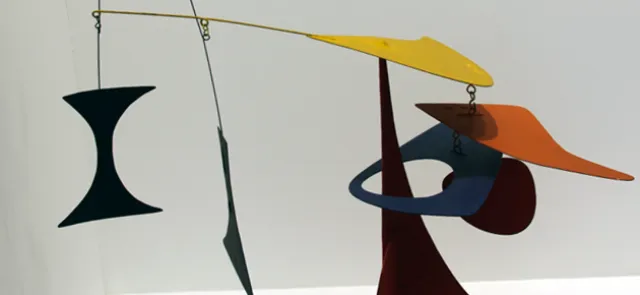
An affine concept inspired by physics
The midpoint of two points and the center of gravity of a triangle are familiar concepts from middle school onward. What do they have in common? How can they be generalized? In the early 19th century, a new approach to geometry put them on a firm mathematical footing through the concept of the barycenter.
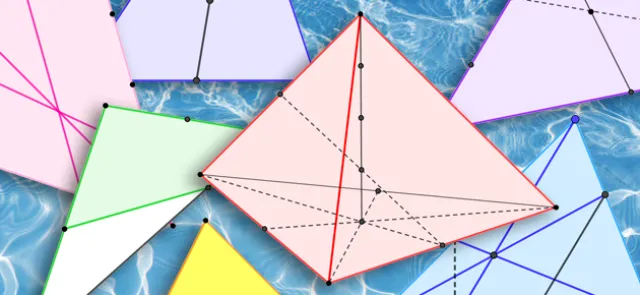
Using barycenters in proofs
First used in physics and mechanics, the concept of the barycenter has proved a rich source of mathematical results. Alignment, incidence, construction and locus problems: geometry can hardly do without it!

Weighted systems in astronomy
Planetary systems are represented mathematically using barycenters.
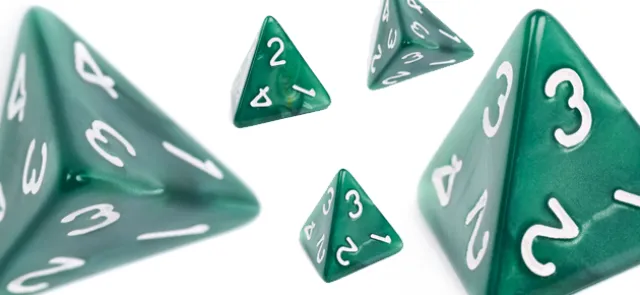
Area and barycenter
Barycentric coordinates offer a fresh approach to Routh's theorem and its applications to several results in Euclidean geometry.

Convex sets and line segments | Tangente
It is fairly easy to tell whether or not a subset of the plane is convex.