In most sports, the athlete's partner is an inanimate, unfeeling object and, ideally, any given movement by the athlete always produces the same effect when performed under identical conditions.
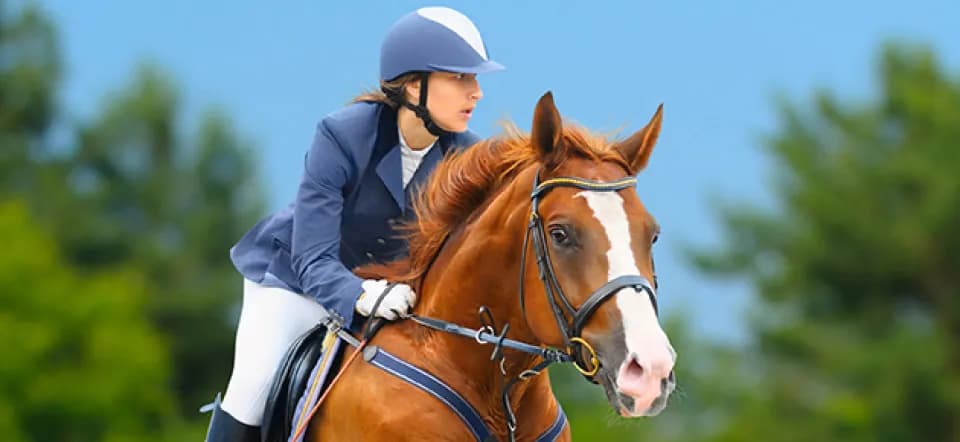
Horse riding is different: two living beings are involved simultaneously. A scientific approach to the discipline therefore hardly seems straightforward a priori. Yet the mathematical concept of the center of mass—the center of gravity in this context—proves useful in show jumping, an equestrian sport in which horse and rider must complete a course of obstacles without incurring penalties.
Show jumping
-------------------
Modeling a jump requires numerous simplifications. The first—and by no means the least—is to represent the rider by a point mass: the center of gravity of the rider's body, carrying the rider's mass. The horse is treated in the same way, as one would, for example, when studying the motion of celestial bodies or the trajectories of satellites. The rider–horse pair is thus represented by a point at their center of mass, with a mass equal to the total mass of both bodies.
To locate the horse's center of gravity, the main consideration is that two-thirds of the animal's mass is concentrated in the forehand: the part of the horse lying in front of a vertical line drawn immediately behind the forelegs. More precisely, the center of gravity of a standing horse lies below the thirteenth vertebra and beneath the line joining the point of the shoulder to the point of the hip—or, depending on the horse's build, approximately on the girth line, slightly behind the withers.