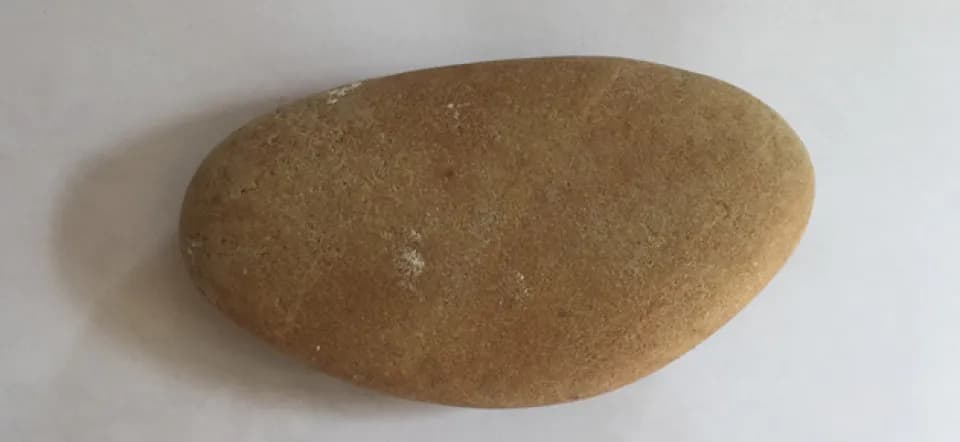
Some toys appear to reverse the direction of their initial motion. This makes them marvellous mathematical objects—and ones that can be analysed, though not without difficulty: the yo-yo, which climbs back up its string after descending; the boomerang, which returns to you if you know how to throw it; the inverting top, or tippe-top (see Tangente 182, 2018), which "inexplicably tips over" as it spins; and the hoop (or hula hoop), which returns to the thrower when sent rolling away with backspin.
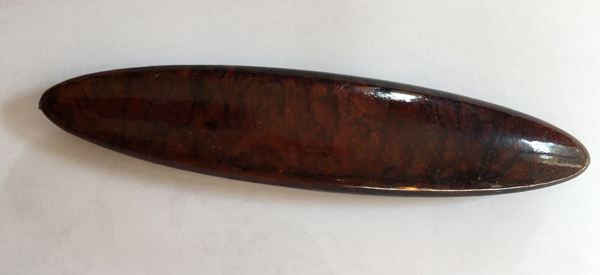
But none of these toys behaves as counterintuitively as the rattleback. The physicist Arthur Dearth Moore (1895–1989) gave it its "official" name, anagyre (from the Greek ana, meaning "return," "repetition" or "backward," and gyro, meaning "circle" or "rotation"). It is also known by various other names, including rebel stone, Celtic stone or wobble stone, spinning bar, curious whirl, rattleback in English, and keltisches Wackelholz ("Celtic wobbling wood") in German.
Three conditions are needed
-------------------------
Irish archaeologists are said to have accidentally (re)discovered the rattleback's properties after observing the unusual motion of a stone axe head or adze spinning on a table—hence the name "Celtic stone." Such "stones" had long been known: as early as 1896, Gilbert Thomas Walker (1868–1958) offered a qualitative analysis of their behaviour, noting that their distinctive motion resulted from a "subtle asymmetry" in their shape (Journal of Pure and Applied Mathematics 28). Quantitative analysis is more difficult, as it must account for slipping and energy loss through friction. The physicist François Graner carried out such an analysis, drawing on studies of the physics and dynamics (in his book Physique de la vie quotidienne, Springer, 2003). More recently, Alexei Tsygvintsev and his team at the École normale supérieure de Lyon published a very thorough mathematical study.