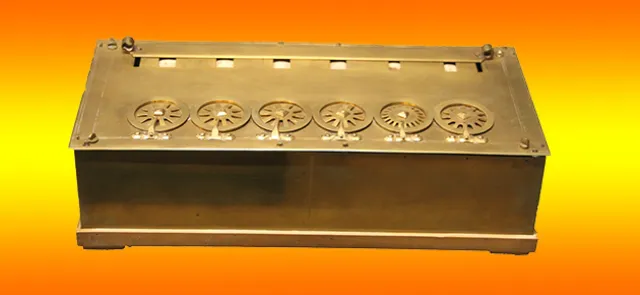
In 1642, Cardinal Richelieu appoints Blaise's father superintendent of Upper Normandy, a position that requires him to perform many long and tedious calculations. Blaise conceives the idea of a machine to help his father: preventing errors would spare him lengthy, laborious checks. Although using a calculating machine is commonplace today, mechanized computation was a novel idea in Pascal's time. In 1645, after three years of work and some fifty prototypes made by clockmakers in Rouen, he presents his first machine. It can perform additions and subtractions.
Specialized models, now rare
---------------------------------
From the outset, Pascal plans to make each digit as independent as possible of the others so that his machine can accommodate as many decimal places as necessary. He also designs a mechanism that can operate in base 10 as well as bases 6, 12 and 20. At the time, a livre was divided into twenty sols, and a sol into twelve deniers; similarly, a toise contained six feet, a foot contained twelve inches, and an inch was itself divided into twelve lines.
From 1649 onward, Pascal adopts a genuinely industrial approach, seeking to reduce production costs so that the invention that made him famous can reach as many people as possible. Yet after producing only a few prototypes, he discovers that a Rouen clockmaker is selling a counterfeit version! He then presents a model to Chancellor Séguier and eventually obtains a royal privilege guaranteeing him exclusive rights to manufacture the machine. Alas, despite his publicity campaign, it proves a commercial failure.
The twenty or so machines actually built were of three types: