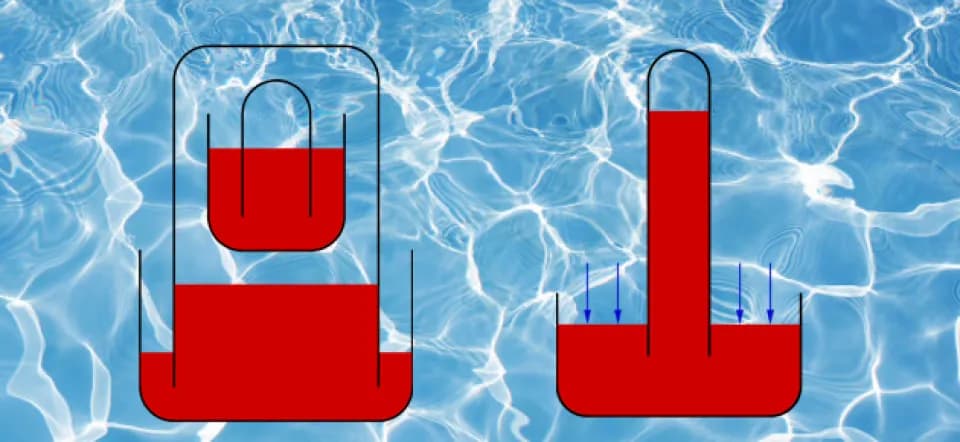
Does the vacuum exist? This question has haunted thinkers since Antiquity. For Aristotle, the impossibility of a vacuum could be proved by reasoning about motion. The motion of a body depends on the resistance exerted by its surroundings. But in a vacuum there is no resistance, so a body's speed would become infinite. The body would then be in two places at once. Absurd! Aristotle therefore concluded that the vacuum did not exist, an idea encapsulated in the famous maxim: "Nature abhors a vacuum." Atomists such as Democritus did conceive of the vacuum, but their ideas would be opposed until the beginning of the 20th century. Epicurus likewise postulated the existence of the vacuum, but his supposed atheism discredited him. By the Renaissance, Aristotelian dogma still prevailed.
An experimental approach
--------------------------
For Pascal, as for Marin Mersenne and Gilles Personne de Roberval, experiments were the sole foundations of physics. In 1644, Torricelli conducted his famous barometric experiment, which Mersenne was unable to reproduce in 1646 because he lacked a sufficiently strong glass tube. Pascal and his father, however, succeeded in Rouen with the help of the engineer Pierre Petit and good-quality glass from a local glassworks. Let us hear Blaise Pascal's account: "Together we went to the glassworks, where I had a blowpipe made [a long cane bored through and hollow along its entire length], four feet long and with an internal diameter the size of a little finger, and had it sealed at one end […]. That done, we went to an apothecary or druggist to obtain as much mercury as we would need […]. We filled our blowpipe very gently […]. Placing my middle finger over the opening of the blowpipe, which was so full of mercury that some spurted out as my finger took its place, we raised it very gently […]. Then, still holding my finger firmly in place and my hand around the blowpipe, I immersed it through the water and mercury until my finger reached the bottom of the vessel, where we spent some time considering whether there might be a little air at the top […]; on the contrary, it was visibly full of mercury throughout. Then, gently withdrawing my finger from the opening and allowing the blowpipe to touch the bottom of the vessel, we saw the mercury descend and leave the top of the tube […]."
In 1647, again in Rouen, Pascal invited the public, including Aristotelians, to attend a demonstration in the glassworks courtyard. There he had commissioned a forty-six-foot crystal tube, some fifteen meters long, which was filled with wine for greater visibility. Using machinery built around a mast, he raised and lowered the long glass tube, clearly showing that the wine level remained at the same height as the tube was tilted, "the upper parts of the tubes otherwise remaining apparently empty, exactly as had been observed with quicksilver". Modern historians have questioned whether this experiment really took place, since making a robust tube some fifteen meters long would have been no easy matter, but several trustworthy contemporary accounts survive.
Pascal's contemporaries offered other interpretations of these experiments: some thought that a little air might remain at the top of the tubes, while Étienne Noël argued that if light could pass through the glass, then "subtle" air might pass through it as well. The many trials conducted with tubes of different shapes invalidated these interpretations.