



A mind curious about science
Pascal's agile mind was kept bubbling by an insatiable curiosity. His precocious genius expresses itself thus in a study of sounds whose good craftsmanship astonishes for his age. Later, he engages successfully in the debates on the existence of the void. Fearing no epistemological leap, and not without a certain taste for controversy, he proves with flair in a famous experiment the accuracy of his reasonings. He does not hesitate to 'put his hand to the work' to make his ideas concrete, as in the design of his calculating machine, a small marvel of clockwork and mechanics.
All articles in this folder
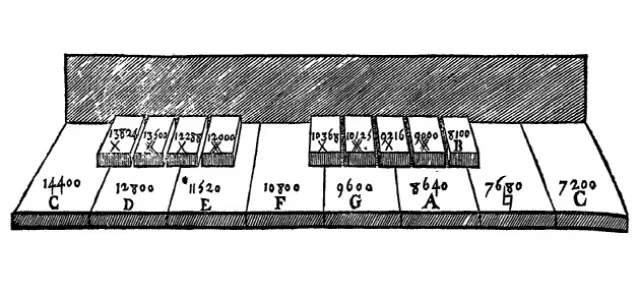
Writing a treatise on sound at the age of 11 | Tangente
The links between music and mathematics are well established. There was a time when it was not unusual for the most learned minds to pursue both with equal delight. Pascal, too, is said to have explored questions relating to sound, further evidence of his astonishing precocity.
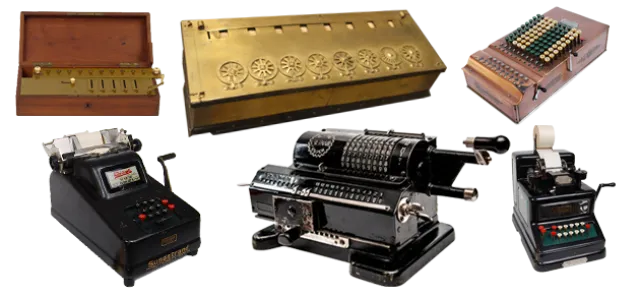
Mechanical secrets of the 1642 Pascaline | Tangente
Electronic calculators, now built into our phones, have made us forget the mechanical marvels that came before them. At just 19, Blaise Pascal developed the first calculating machine and, after a hard struggle to perfect his invention, captivated his contemporaries.
The birth of Pascal — Niklaus Wirth | Tangente
The Pascal programming language was specified in 1968 and designed in the 1970s by Niklaus Wirth (born 1934) at the Swiss Federal Institute of Technology (ETH) in Zurich, Switzerland.
A Pascal-inspired teaching tool | Tangente
The best way to grasp the basic idea behind the Pascaline is to try it for yourself. Unfortunately, playing with the few surviving models held in museums is obviously out of the question.
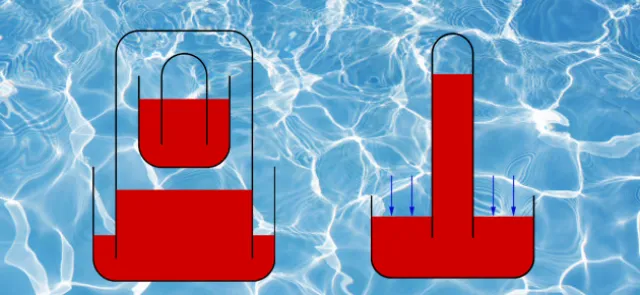
Pascal: The man who wasn't afraid of the void | Tangente
In the 17th century, following the Ancients, it was held that "nature abhors a vacuum." By restoring physical experimentation to the heart of scientific inquiry, French scholars of the period would thoroughly reassess this claim. Pascal would devise an ingenious apparatus for "creating a vacuum."

The pascal: the SI unit of pressure | Tangente
Pressure—the magnitude of a force per unit area—is often measured in pascals, denoted Pa.