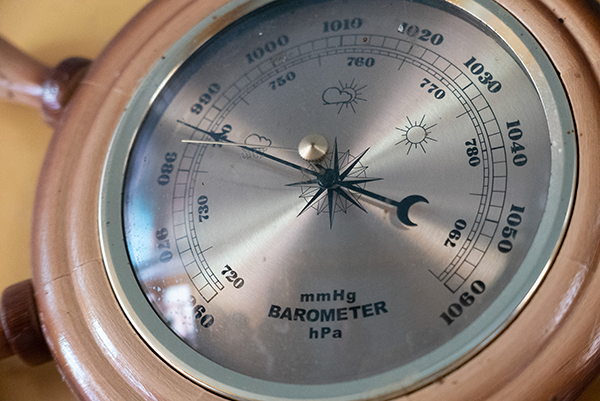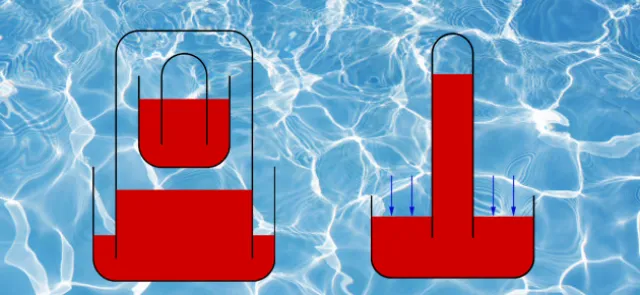
By definition, 1 Pa = 1 N / m2 (one newton per square metre). The pascal is derived from the base units of the International System of Units—the kilogram, metre and second—via the equation 1 Pa = 1 kg·m–1·s–2. This unit is "fairly small"; in practice, multiples such as the hectopascal, hPa (102), and the megapascal, MPa (106), are used. Other units of pressure are used outside the International System of Units. One such unit is the bar, used in hydraulics and oceanography, which is equal to 105 pascals. There is also the standard atmosphere (atm), equal to approximately 1,013 hPa and based on the mean atmospheric pressure at sea level, as well as the millimetre of mercury (mmHg), used to measure blood pressure and very close to the torr (named in honour of Torricelli), which is equal to 1/760th of an atmosphere.
The name was proposed in the 1950s and adopted in France in the early 1960s. It was not until October 1971, however, that the pascal was officially approved at the fourteenth General Conference on Weights and Measures in Paris, alongside the siemens, the unit of conductance (1 S = 1 Ω–1), and the mole, the base unit of amount of substance.