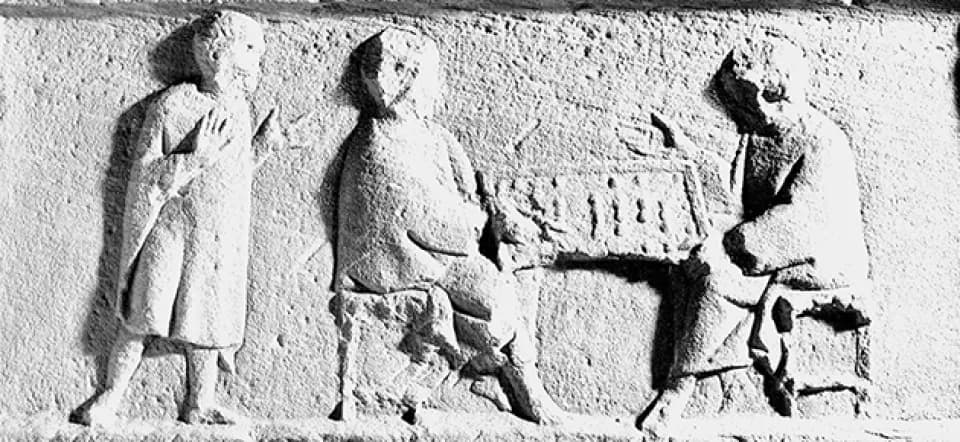
Today we calculate using Hindu-Arabic numerals, a positional decimal system, and methods that came to us from India. Attested around the 6th century, these methods were described in Baghdad around 825 by al-Khwarizmi, a scholar whose Latinized name gave us the word "algorithm." But how did people calculate before that? Surprisingly, the question is difficult to answer: everyday calculation, particularly in trade, has left few historical or archaeological traces. Nevertheless, the research points to one answer: people calculated with pebbles (called calculi in Latin) arranged on counting boards. Let's explore what is known about these objects, particularly in the Mesopotamian, Greek and Roman worlds, drawing on the website of the association L’aventure du calcul (**www.aventureducalcul.fr*). Much of its material on these counting boards comes from publications by Alain Schärlig and Jérôme Gavin, authors familiar to readers of Tangente*.
Dust tables
-----------
The Sumerian numeral system used in Mesopotamia is one of the oldest described by archaeologists; it relied on calculi whose shapes and sizes varied according to their values. Suited to the base-60 system used for calculation (the sexagesimal system), these values were 1, 10, 60, 600, 3,600 and 36,000.
The calculi were used to record numbers and perhaps also to perform everyday operations. Calculating would then have involved manipulating these pebbles on a table, probably a counting board (or abacus), a word that originally meant a "dust table": a wooden board covered with a thin layer of sand on which characters or guide lines could be drawn. Unfortunately, although many Mesopotamian mathematical clay tablets survive with the results of exercises or problems, we have little information about the calculation methods they used.
One day, a scribe had the brilliant idea of making a pebble’s value depend on where it was placed on the counting board, instead of fixing that value through the shape of the calculus itself, as in the Sumerian system. The calculi thus became interchangeable counters whose values depended on the grid marked on the board. Here again, these counting boards made "in the dust" have left few archaeological traces in Mesopotamia or Egypt. Fortunately, some thirty stone examples have survived from the Greek world, including the Salamis Tablet! In a corner of the marketplace on the island of Salamis, an accountant would go about his work on just such a counting board, using calculi (or psèphoï in Greek).