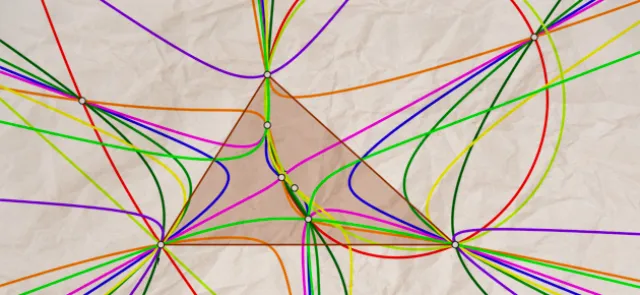
Studied by the Italian mathematician Ernesto Cesàro (1859–1906) in the 1880s, these curves are based on an initial curve (Γ0), often called the fundamental line. A barycentric curve associated with (Γ0) is the locus of the centers of gravity of arcs of (Γ0), measured from a fixed point on (Γ0). Here, the "center of gravity" should be understood as the barycenter of a continuum of points.
The velocity vector of these successive centers of gravity always points toward the corresponding point on the fundamental line, making the barycentric curve a pursuit curve (see Courbes et Trajectoires, Bibliothèque Tangente 74, 2021). Of course, a given fundamental line has infinitely many associated barycentric curves, depending on the fixed point chosen.
Let's look at a first example. In the plane with an orthonormal coordinate system, take a line (D) as the fundamental line and any point on it as the fixed point. The associated barycentric curve is then (D) itself.
Now take the unit circle centered at O (0, 0) as the fundamental line, with the point F with coordinates (1, 0) as the fixed point. As M0 travels around the circle, the current point M on the barycentric curve is therefore defined as the center of gravity of the arc . In the adjacent figure, the point M0 has traveled around the circle five times. The associated barycentric curve (in red) is a cochleoid. Its parametric equations are
Described in 1699 by the British mathematician John Wallis (1616–1703), the cochleoid can also be defined as the central projection of a circular helix when the center of projection lies on the helix itself.
REFERENCE
The Mathcurve website (www.mathcurve.com, an online encyclopedia of remarkable shapes), maintained by Robert Ferréol.