The book Recherches sur les courbes à double courbure takes up a new subject. Since the 17th century, geometers throughout Europe had studied many plane curves, first using Descartes’s ideas about coordinates and then Newton and Leibniz’s revolutionary methods of differential and integral calculus. They had had little opportunity to consider space curves, although Henri Pitot (1695–1771) had presented a paper to the Académie des sciences. In a 1724 paper, this hydraulic engineer studied a type of helix and concluded: "Perhaps these kinds of curves of double curvature, or curves lying on the surfaces of solids, will one day become a subject of research for geometers." Clairaut promptly took up the challenge.
A groundbreaking first book
-------------------------
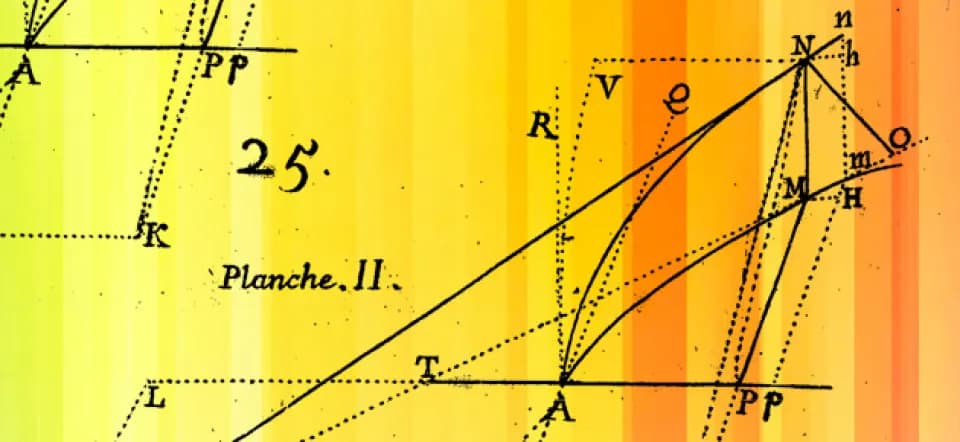
In his preface, he explains his approach: a curve in space can be studied by considering its projections onto the planes of a solid angle (today we would say the three planes of a trihedral angle). Two of these projections are enough, and the curve in space "so to speak, always shares in the curvature of these two curves"; this is what justifies the term "curves of double curvature."
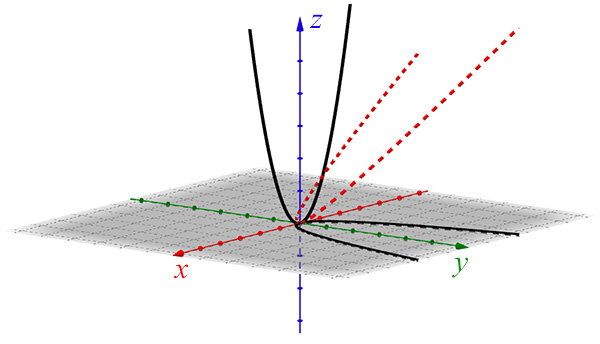
The book remains an enjoyable read even today, provided you have paper, a pencil and dynamic-geometry software to hand. Clairaut gives a great many examples. In the first part, he studies curves of double curvature specified by two projections onto the coordinate planes, showing that the curve is the intersection of the two cylinders constructed from these projections. In his examples, the projections are often conics. It is interesting to picture for ourselves what the curve looks like from its projections… Let’s consider, for example, the following figures.