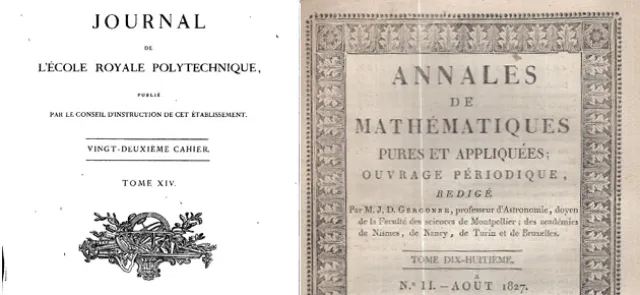
Mathematicians now regarded as iconic figures in science have not necessarily always enjoyed that status. Joseph Fourier (1768–1830), for example, is now one of the best-known scientists in the world thanks to his research: every engineer knows his name! Yet he was largely overlooked in the second half of the 19th century. What about Clairaut? Books, journals and mathematical dictionaries published at the time offer a few clues.
A successful author
------------------
A survey of printer-booksellers’ output throughout the 19th century shows that Clairaut’s Élémens de géométrie—as the title was spelled at the time—went through several editions: in 1830, 1852, 1853 and 1861. Alongside these reissues, 1833 also saw the publication of Élémens de géométrie d’après les élémens de Clairaut by Jean-Baptiste François Étienne Ajasson de Grandsagne (1802–1845).
This edition was successful enough to be reissued the following year, in 1834. It was a highly practical book, with a section on the use of "various mathematical instruments: set square, protractor, proportional compasses, etc."
In 1853, Éléments de géométrie par Clairaut appeared, a new edition adapted to the decimal system by one Honoré Regodt, "professor at the Association phylotechnique de Paris" and the author of numerous books on a wide variety of subjects. Throughout the 19th century, Clairaut’s geometry thus inspired many authors. The same is true, though probably to a lesser extent, of his Élémens d’algèbre, which reached a fifth edition in 1824.