Consider the equation *x 2 + x – 1 = 0. A calculation shows that its unique positive solution is
This equation is equivalent to x (x* + 1) = 1, and hence to
Now replace the x in the denominator with giving
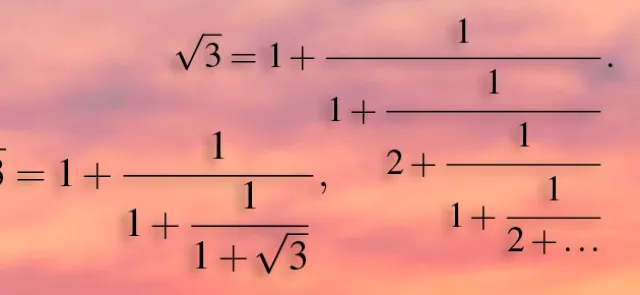
There is nothing to stop us repeating the process again and again, suggesting that x can be written as a fraction that "never ends"—what is known as a continued fraction: