



When fractions continue
They continue, the fractions! Fundamentally confined to the set of rational numbers, they nevertheless manage to escape it when we let them continue to infinity. On this topic, there are multiple ways to do it. One of them consists in adding them again and again, to get closer and closer to irrational numbers like π. A second possibility consists in arranging fractions in a binary tree to obtain them all. Finally, a major method, algebraic or arithmetic techniques make it possible to construct fractions of fractions, which continue to infinity and thus define... continued fractions.
All articles in this folder

Fractions in the temple of integers?
As its name suggests, Neil Sloane's On-Line Encyclopedia of Integer Sequences contains only integers. Yet there is a roundabout way to introduce fractions into it…

Endless sums
Adding several fractions always produces another fraction. But when the sum continues indefinitely, things are very different. If chosen carefully, such sums can approximate numbers like π and yield a wealth of fascinating, unexpected results.
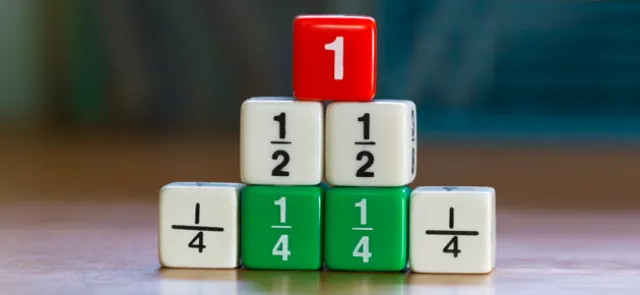
Fractions of fractions, full speed ahead
A very simple way of constructing a sequence of fractions can lead to surprisingly deep mathematical tools. Here is an example that leads to the famous Prouhet–Thue–Morse sequence and its many applications.

Denominators without end
Continued fractions—stacks of fractions that never end—have been studied by some of the greatest mathematicians, including Euler and Lagrange, as well as Galois. Let's take a closer look at these fractions and their strange denominators.

A genealogy of fractions
A beautiful construction due to Calkin and Wilf, foreshadowed a century earlier, provides an elegant and deep way to list all fractions. Beginning with 1 / 1, each fraction in this construction gives birth to two new ones.