Why distinguish between two types of irrational number, algebraic and transcendental? Where did this idea come from? Let us return to the mid-18th century, when fractions were well understood and rational numbers had come to be regarded as numbers in their own right. Proving whether or not a number is irrational was becoming a matter of interest. Leonhard Euler was first off the mark with his favorite number, e = exp(1), the base of natural logarithms, proving that both it and its square are irrational. His proof appeared in his 1737 work De fractionibus continuis, in which he expressed the number as a continued fraction. The German mathematician Johann Lambert (1728–1777) joined the Berlin Academy in 1765, where he worked alongside the Swiss mathematician. Inspired by Euler's method, he proved more generally that if x is a nonzero rational number, then exp(x) and tan(x) are irrational; he also proved that π is irrational.
####
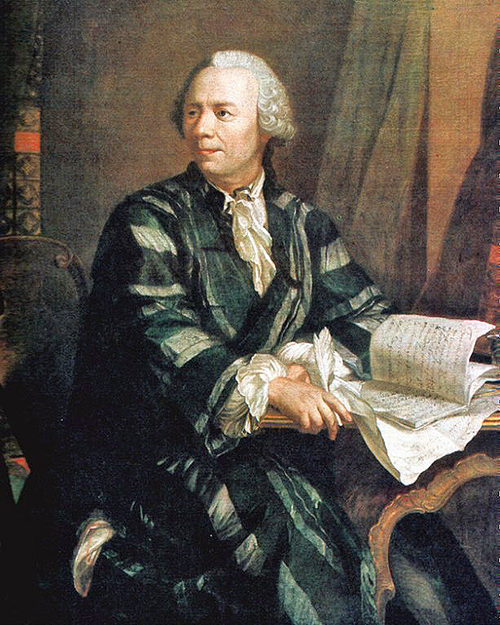
Leonhard Euler (1707–1781).
To gain a better understanding of these numbers, it is natural to ask whether they might be roots of polynomial equations with integer coefficients (or rational coefficients, which amounts to the same thing after clearing denominators and simplifying). Euler may have been the first to take up this question, perhaps as early as 1744.