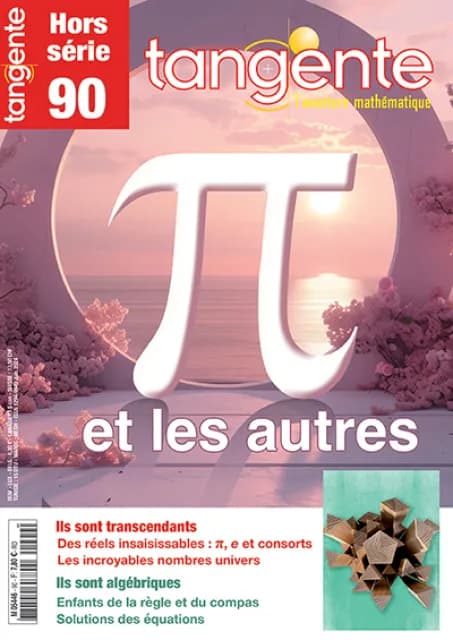
pi and the others
All folders in this issue
The king of numbers
It is undoubtedly the most famous constant in all of mathematics after 0 or 1. The number π, whose history spans several millennia and continues to be written to this day, exerts a manifest fascination. Is it because of its omnipresence in geometry and its link with this perfect shape that is the circle? Or because the infinite sequence of its decimals seems totally random? Or yet because of the abyss that separates the simplicity of its definition from the difficulty one has in establishing its properties? What is certain is that π continues to give work to scientists and to intrigue us.



Transcendental friends
The emergence, in the time of the Greeks, of the notion of irrationality, with the impossibility, for certain numbers to be written as a quotient of integers, was a highlight of mathematics. Each new number was then subjected to the question: fraction or irrational? The proof, in the 19th century, of the irrationality of numbers like π or e, added a degree to the categorization: unlike others, such as √2, they were not solutions of a polynomial equation with integer coefficients. They were named transcendental, as if to remind that they came from a higher world. In fact, almost all real numbers are transcendental but for some irrationals, the question remains open.



The family of algebraic numbers
In the universe of real numbers, when one is not transcendental, one is algebraic. That is to say, for the latter, solutions of an algebraic equation with integer coefficients. This is the case, for example, of all numbers constructible with a ruler and compass. But even if some can be written using radicals, this is not the case for all of them and their study often brings us back to the theory of equations initiated by Galois in the 19th century. Another specificity of the set of algebraic numbers is to possess a structure: the sum, the product and the quotient of two of them is still algebraic. We are therefore in the presence of a field, a very important notion in modern algebra.