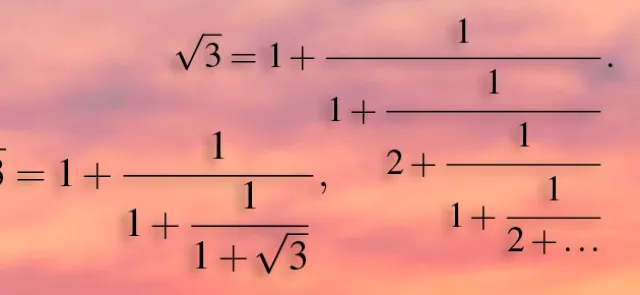
When constructing the main sets of numbers, we generally begin with the integers and then the rational numbers, which are quotients of integers, before observing that an expression such as cannot be written as a fraction. Often, no sooner has this observation been made than we hasten to point out that and their little friends, such as or , are also irrational. They too can therefore claim a place in the world of numbers, considerably expanding its boundaries.
Yet instead of embarking at once on such a vast exploration, we can pause to examine what happens when just one square root is introduced. This brings quadratic fields to light. These distinctive realms have structures of their own, extending that of the rational numbers with surprising regularity.
Quadratic fields extend the structure of the rational numbers
---------------------------------------------------------------------------
Let's start with the case of . We start with the set ℚ of rational numbers (those that can be written as a quotient a/b, where a and b are integers), and adjoin together with all the numbers that can be generated from and the rational numbers using the four arithmetic operations: addition, subtraction, multiplication and division. The resulting set of numbers is denoted by ℚ(). Extending the set of fractions in this way using a square root produces a quadratic extension. By construction, this set is a field (see box).