-
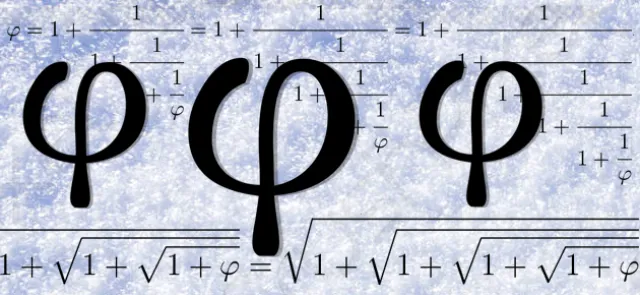
The golden ratio (see "The first irrational numbers"), whose value is is related to the Fibonacci numbers (see "To belong, or not..."). It is the limit, as n tends to infinity, of the ratio . To see why, note that this ratio has a positive limit satisfying the equation x2 ‒ x ‒ 1 = 0: it really is the golden ratio!
The Fibonacci numbers can be generalized: the Tribonacci numbers are defined in the same way, by a third-order recurrence relation:
*Tn = Tn*‒1 + *Tn*‒2 + *Tn*‒3 for every n ≥ 3, with T0 = T1 = 0 and T2 = 1.
The first terms are therefore 0, 0, 1, 1, 2, 4, 7, 13, 24 and 44. The name chosen for these numbers reveals a certain mathematical sense of humor! So what is the limit, as n tends to infinity, of the ratio ? It can be shown to be the only positive root of the equation x3 ‒ x2 ‒ x ‒ 1 = 0; its approximate value is 1.839286755, and its exact expression is . It is sometimes called the silver ratio (one wonders why...)! We shall call it the Tribonacci constant here, since there is another silver ratio, a member of the family of metallic ratios (see Tangente 203, 2022), defined as the positive root of the equation
x2 ‒ 2x ‒ 1 = 0 and equal to .