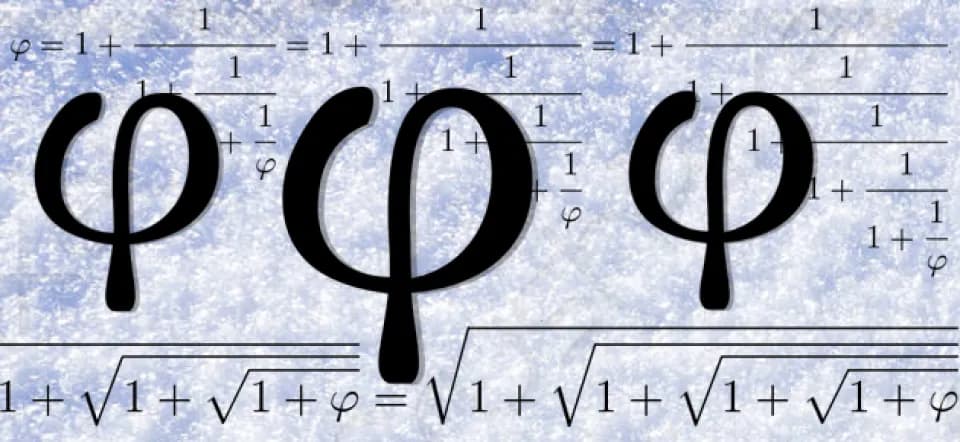
The golden ratio is often denoted by the Greek letter φ ("phi"). This is probably a reference to the Greek sculptor Phidias (c. −490; c. −430), whose influence was considerable and who may have created the sculptures of the Parthenon in Athens. This is the symbol used for the golden ratio throughout this feature. Other authors denote it by capital Phi or another Greek letter, τ ("tau").
A particularly elegant modern definition of φ is as the positive solution of the following quadratic equation: x2 − x − 1 = 0.
Using the familiar quadratic formula, we find whose approximate value to within 10 −6 is 1.618034. We can, of course, calculate an approximate value to as many decimal places as we wish, but since the real number is irrational (it cannot be written as the quotient of two integers), the decimal expansion of φ can neither terminate nor become periodic beyond a certain point (as does, for example, 0.892857142 85714285714…, in which the sequence of digits "285714" repeats indefinitely after the initial digits 0.89: this decimal expansion represents the number 25/28).
A cascade of equalities
-----------------------
The other solution φ’ of our quadratic equation is negative. Using the same formula, we find its value:
Its approximate value to within 10 −6 is −0.618034. Since the product of the roots of the equation is −1 (the equation can also be written (x − φ) (x − φ’) = 0), we have φ’ = −1 / φ.