



The truth about the golden ratio
The golden ratio can be simply defined by the quadratic equation of which it is one of the roots. But its multiple geometric and arithmetic properties made it a mystical object at certain times. Discovered in ancient constructions or in our natural environment, it has even, under the name "divine proportion", been considered as the aesthetic canon of works of art, or even, since the Pythagoreans, as proof of the harmony of the world. This feature aims to place it back in an objective universe by separating the mathematical constructions, how clever they are, that it has allowed, from the deliriums of which it has sometimes been the object.
All articles in this folder
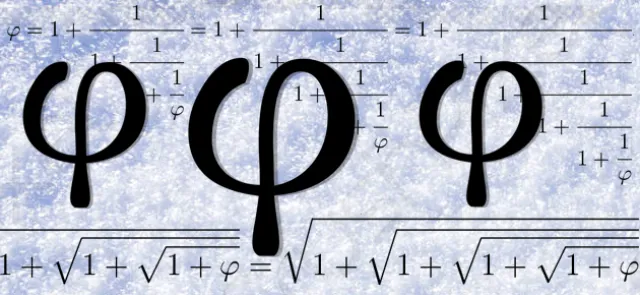
Remarkable mathematical properties
At first glance, the golden ratio, despite its mythical name, is nothing exceptional mathematically: it is simply the positive solution of a quadratic equation. Much ado about nothing? Let's see, then, what surprises it has in store.

Phi is irrational: a geometric proof | Tangente
Let's see how to prove that φ is irrational.

Gold, yes... but metal too
Mathematics enthusiasts—and mathematicians themselves—have no shortage of imagination! Starting from the golden ratio, some have defined a family of numbers known as metallic means that share certain properties with the golden ratio.
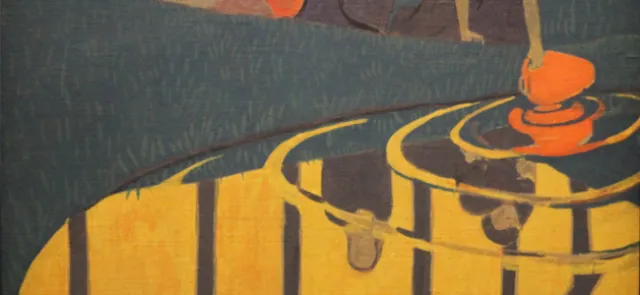
Golden ratio in art: between myths and realities | Tangente
However you look at the paintings, it is hard to substantiate the idea that the golden ratio's presence in art gives a work some decisive aesthetic quality. Let's see where φ really lurks...

Golden ratio in nature: fact or myth? | Tangente
The myth that the golden ratio is found in nature is remarkably persistent.
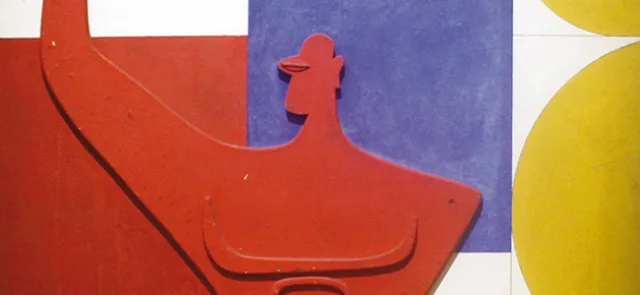
An architect's dream?
The golden ratio, as everyone knows, crops up everywhere in art... provided, that is, you are determined to find it and willing to overlook (!) a few approximations or anachronistic units of measurement. Let's trace the writings that linked it to architecture and brought it to public attention.