Whenever the golden ratio is mentioned, its supposed aesthetic virtues immediately spring to mind. How can a mere number, even one so rich in mathematical properties (see the article "Remarkable mathematical properties"), hold such a prominent place in the collective imagination? It was defined geometrically as dividing a line segment in extreme and mean ratio, but that hardly seems to justify its status as a "divine proportion" governing the laws of aesthetics. In their book *Le Nombre d'or, radiographie d'un mythe* (The Golden Ratio: Anatomy of a Myth), published by Seuil in 1995, Marguerite Neveux and Herbert Huntley attempt to trace the course of this mystification from Euclid to Matila Ghyka.
The search for φ in painting
------------------------------
The golden ratio was already known to Pythagoras, Plato and Euclid. It reappeared in a text by Luca Pacioli, who called it the "divine proportion " in his book De divina proportione; for him, this proportion evoked God, not beauty. The myth of the golden ratio as the ideal proportion was spread chiefly through the writings of the philosopher Adolf Zeising and, above all, Matila Ghyka, who recounted the supposed chain through which the "golden section" had been handed down (see the article "An architect's dream?"). To justify the golden ratio's supposed aesthetic supremacy in art, pseudoscientific studies were conducted that perpetuated the myth, which was then taken up by writers, journalists and art critics with a taste for mysticism. The experimental aesthetics of the philosopher and psychologist Gustav Theodor Fechner (1801–1887) helped lend credence to this claim: his statistical experiments led him to assert that viewers showed a marked preference for the "golden section," with the golden rectangle preferred over other rectangles. These results were nevertheless contradicted by other experiments. Swept along by the supposed aura of φ, art critics and even artists threw themselves into this mystical hunt for the golden ratio. Works were analyzed and dissected, imaginary lines were suggested across the surfaces of the canvases, and whenever ratios of lengths close to 1.618 emerged, hasty conclusions were immediately drawn and a link proclaimed between a painting's aesthetic appeal and the presence of φ. This a posteriori search for the golden ratio in paintings has often proved contrived and takes no account of the artist's intentions. Sandro Botticelli's (1445–1510) The Birth of Venus has been scrutinized at length in an effort to detect φ. The painting measures 278.5 cm × 172.5 cm, giving a ratio of approximately 1.614. But does that really allow us to conclude that Botticelli deliberately chose this ratio, which is "close" to φ? If we look at other paintings by Botticelli that are just as widely acclaimed for their beauty, we find Primavera (1478–1482), which measures 203 cm × 314 cm (a nod to π?), giving a ratio of approximately 1.546—clearly some distance from φ. The Mona Lisa has likewise been dissected, and some claim that her face fits inside a golden rectangle—an especially subjective judgment.
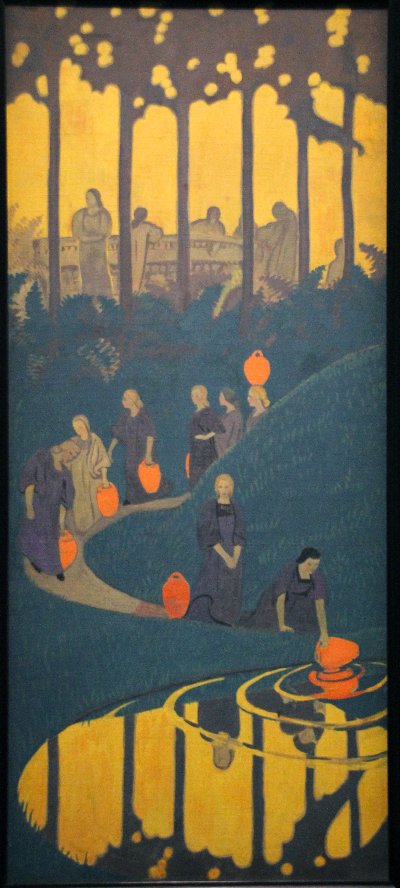
Artists have, of course, often sought rules that might bring them as close as possible to a "perfect" aesthetic, whether through perspective, color harmonies or the use of proportions. Although many simple proportions have been used, φ does not seem to have featured any more prominently than these elementary ratios. Some artists remained entirely untouched by the fascination with the golden ratio and never incorporated it into their work; others sought a universal beauty governed by proportions deemed ideal, such as 1/4, 3/8, 1/2, 5/8 and 3/4, as in the work of Georges Seurat (1859–1891), or the rule of thirds used by photographers. The fraction 5/8, the quotient of two consecutive terms of the Fibonacci sequence, is equal to 0.625 and is therefore sometimes compared with 1/φ, which is approximately 0.618. Finally, some artists were unwavering in their admiration for the golden ratio and sought to incorporate it into their work. These included Paul Sérusier (1864–1927) and Maurice Denis (1870–1943), who embraced the theories of Zeising or Ghyka. They championed an "ideal painting" governed by very strict laws and employing the golden ratio, a mystical symbol that would supposedly make it possible to attain a kind of perfection, an absolute Beauty governed by divine laws. In practice, they made little use of φ in their compositions, perhaps because it was difficult to apply, unlike simpler divisions, which were easier to use.