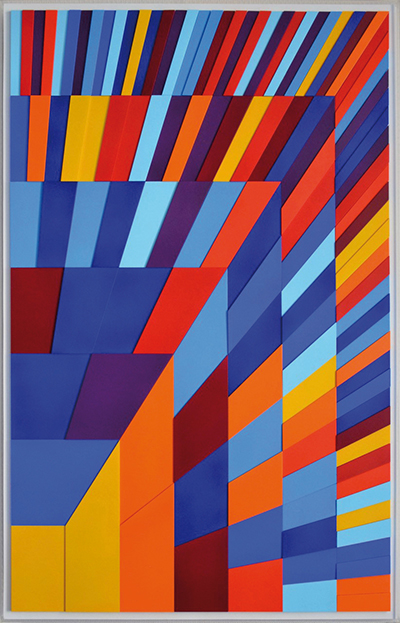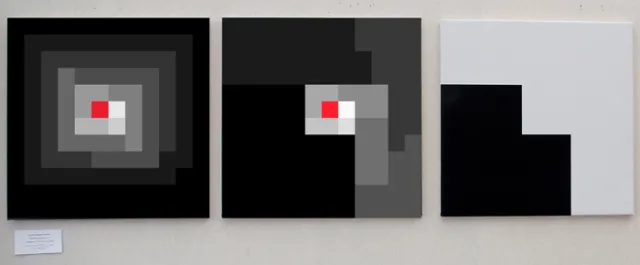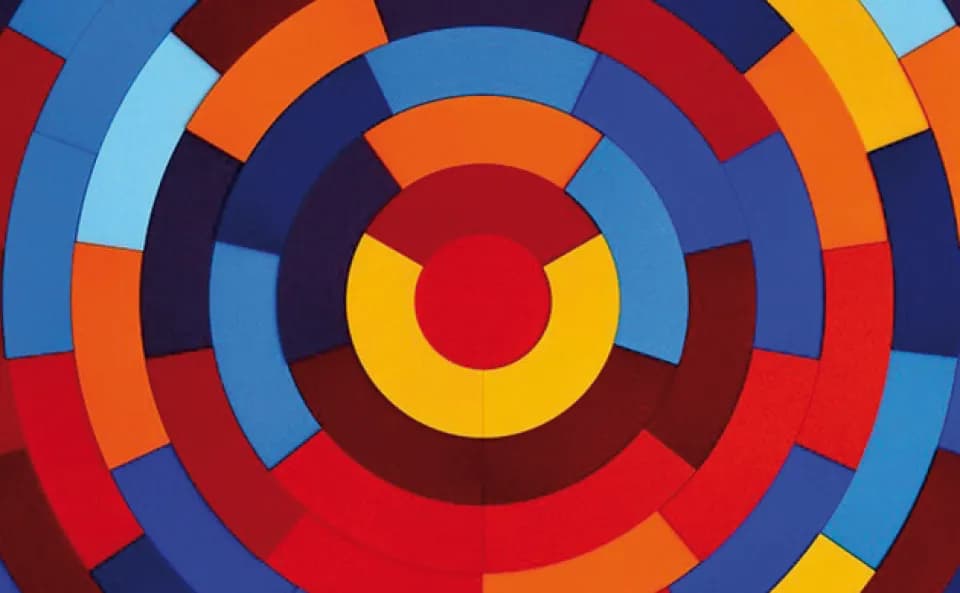
Philippe Leblanc is a Belgian artist born in 1964. Trained as an architectural engineer, he works in the tradition of geometric abstraction. His art employs a variety of materials, including paper, metals, Plexiglas and wood, and features mathematical concepts such as proportions and sequences—most notably the emblematic Fibonacci sequence. He is also interested in algebraic numbers such as the golden ratio φ and the irrational numbers and , as well as transcendental numbers, including π and, very recently, e. Philippe Leblanc develops a variety of procedures to create his works. For example, he uses a system of notation in which digits are replaced by areas of color—either bright colors or shades of gray—which he arranges into puzzle-like compositions. He also seeks geometric shapes that evoke these numbers; π, for example, is represented within a circle.
Gold and roots
---------------------------
For the golden ratio, , the artist chooses two geometric shapes associated with it. The first is a golden rectangle, whose sides are in the golden ratio; the second is a pentagon, for whose construction the golden ratio is essential: in a regular pentagon with side length a, each diagonal has length a φ.
Inside these two figures, he places colored shapes corresponding to each digit in the decimal expansion of φ.