



The family of algebraic numbers
In the universe of real numbers, when one is not transcendental, one is algebraic. That is to say, for the latter, solutions of an algebraic equation with integer coefficients. This is the case, for example, of all numbers constructible with a ruler and compass. But even if some can be written using radicals, this is not the case for all of them and their study often brings us back to the theory of equations initiated by Galois in the 19th century. Another specificity of the set of algebraic numbers is to possess a structure: the sum, the product and the quotient of two of them is still algebraic. We are therefore in the presence of a field, a very important notion in modern algebra.
All articles in this folder
New numbers with Richard Dedekind
The real numbers include the rational numbers—the quotients of two integers—and the irrational numbers, of which √2 and π are two well-known examples. This gives us one way of classifying the reals. But another classification is possible, based on numbers known as algebraic numbers.

The spirit of quadratic fields
Why keep adding more and more elements to the set of known numbers? Adjoining just one number to the rationals and combining it with them is already enough to produce many sets with a wealth of wonders to reveal.
When algebra meets geometry
Some real numbers have a geometric origin: they are defined by straightedge-and-compass constructions. Although the basic idea seems simple, the properties of these numbers are not always easy to establish. This is where algebra proves indispensable.

The first irrational numbers
The square root of 2 and the golden ratio are algebraic numbers that are relatively easy to define. Yet they have gone down in history as the first known irrational numbers, with perhaps, in the latter's case, a touch of the "divine."

Free radicals
Being algebraic does not mean being expressible in radicals.
Algebraic numbers among other numbers
Algebraic numbers that count...
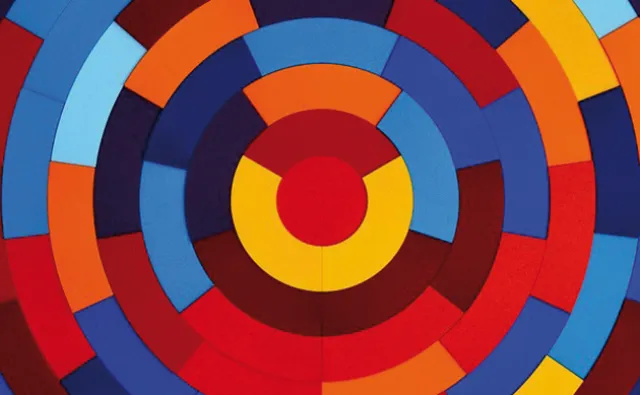
Philippe Leblanc,
Visual artist Philippe Leblanc describes his artistic development this way: "Discovering Op Art, kinetic art and the abstract geometry of the 1960s and 1970s had a decisive influence on my artistic direction." Mathematical concepts and emblematic numbers are recurring features of his work.