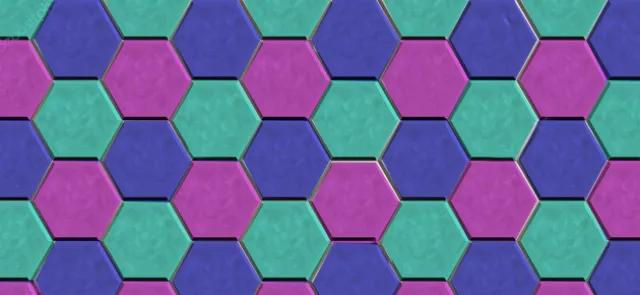
When we think of groups in art, periodic tilings of the plane come to mind first. These tiling groups, sometimes called wallpaper groups, number 17 (see the article "Symmetries that leave objects invariant").
The plane is tiled using a single "tile" chosen from arbitrary parallelograms, rectangles, squares, rhombi or regular hexagons. Regular tilings have already received extensive coverage in our pages (see Tangente 99, 2004; Maths et Arts plastiques, Bibliothèque Tangente 23, 2019; and Découpages et Pavages, Bibliothèque Tangente 64, 2018).
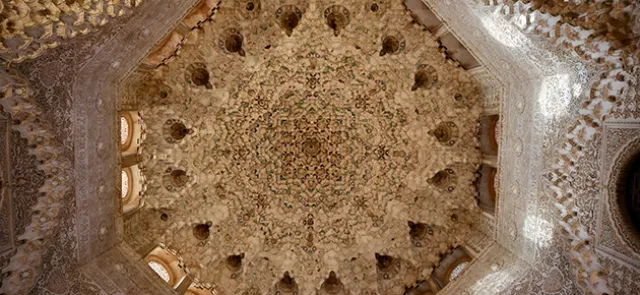
These periodic tiling groups are widely used in art and architecture. The craftsmen who created the sumptuous decoration of the Alhambra in Granada and the printmaker Maurits Cornelis Escher (1898–1972) left us outstanding examples of their skill. Escher is surely the artist who gave us the finest illustrations of regular tilings. He began with these basic geometric "tiles" to create a regular grid, then applied patterns representing animals or human figures to it.
Gerhard Richter and the permutation group
--------------------------------------------
The German artist Gerhard Richter (born 1932) creates works resembling color charts, composed of squares in different colors, such as his series 1024 Farben ("1,024 Colors"). For this series, he began with the three primary colors and gray, then combined them in every possible way. This gave him 4 × 4 = 16 new colors, which he combined once more with the original four to produce 16 × 4 = 64 new shades. Repeating the process, he next reached 64 × 4 = 256 and finally 256 × 4 = 1,024 shades. He chose to depict 1,024 squares on a canvas and color each one in one of these shades. After numbering the colors, he drew the numbers at random from slips of paper; the order of the colored squares was thus generated randomly to give the result a "diffuse and random" appearance. In this way, he obtained an element of the permutation group on his 1,024 colors. He did the calculation: "If I had painted every possible permutation, light would have taken more than four hundred trillion years to travel the distance from the first image to the last", since the exact number of these permutations is 1024 × 1023 × 1022 ×… × 2 × 1. This number is truly staggering: it is approximately 5.4 × 102639.