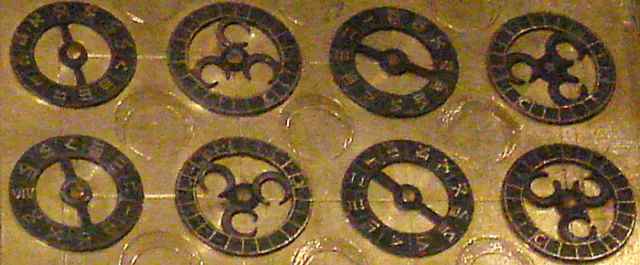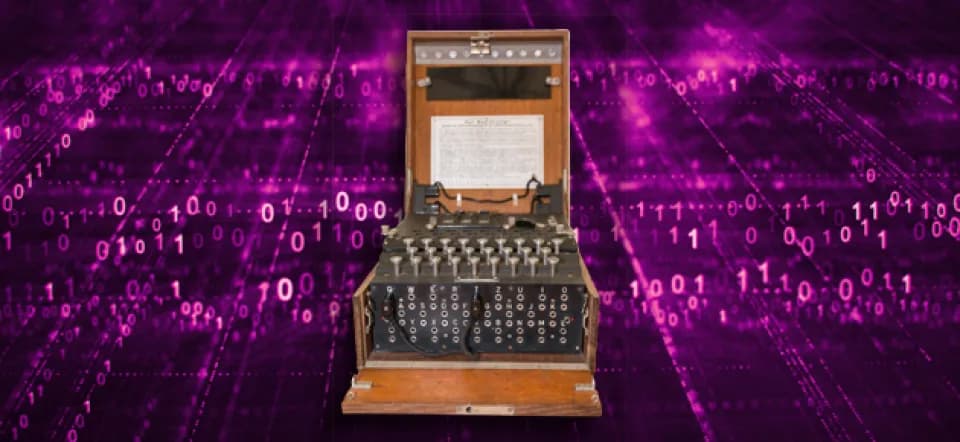
Enigma is an electromechanical machine used to encrypt and decrypt information. It was invented by the German engineer Arthur Scherbius (1878–1929), building on a 1919 patent by the Dutchman Hugo Alexander Koch (1870–1928). Its mechanism contains several rotors.
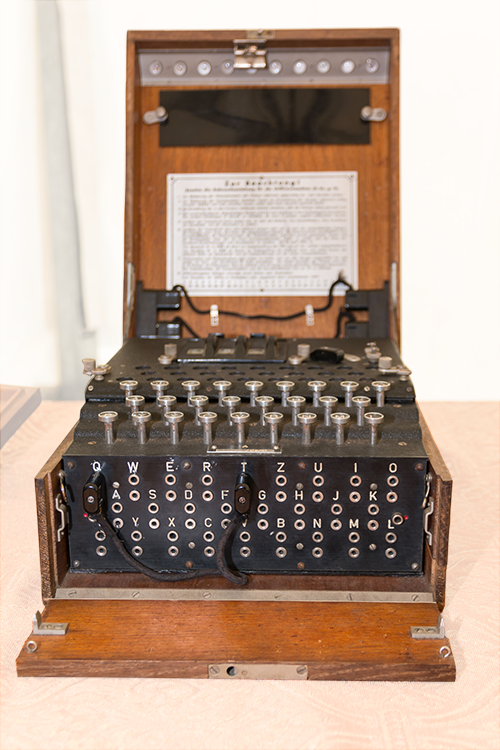
An Enigma machine.
Better than a novel!
-------------------
Contrary to popular belief, the first successful breaking of Enigma owed nothing to the British mathematician Alan Mathison Turing (1912–1954), or indeed to any member of his team at the specialist intelligence services based at Bletchley Park in England. It resulted from an alliance between French intelligence and the brilliance of three Polish mathematicians: Marian Rejewski (1905–1980), Jerzy Rozycki (1909–1942) and Henryk Zygalski (1908–1978). On the intelligence side was Hans-Thilo Schmidt (1888–1943), a German civil servant at the Cipher Bureau who betrayed his country not out of democratic conviction, but for money. From 1931 to 1938, he supplied the encryption tables and operating instructions for the German army's Enigma, along with a wealth of other information. Using Schmidt's intelligence, the mathematicians were able to reconstruct the wiring of the military version of Enigma and build replicas as early as 1933. This breakthrough was made possible by a flaw in German procedure: the initial rotor settings, RAS for example, were given at the start of each message. To prevent transmission errors, the three letters were repeated, producing RASRAS in this case. The two Rs, the two As and the two Ss were therefore encrypted differently as the right-hand rotor advanced, revealing part of its wiring.