The earliest encryption methods rely on cipher alphabets that change each letter. Here is one example, dating from 1627, held in the Strasbourg archives.
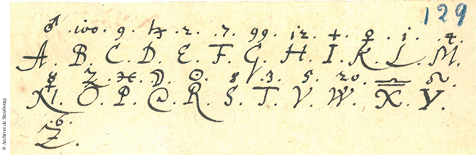
To use it, each letter from A to Z (with I and J treated as one letter, as are U and V) is replaced by the symbol written above it. This is known as monoalphabetic substitution. The cipher is easy to break once the message is at all long. First, calculating the frequency of each symbol reveals the substitute for E, the most frequent letter in French. The next letters are SAINTURLO, which can be remembered by saying that Urlo is the patron saint of cryptologists. The next step is to identify words that are likely to appear, which is often possible. For example, a message sent from a besieged fortress can reasonably be expected to contain a word such as "munition". One can then look for it through the repetitions it contains, namely \\xy\y\x, where x and y are two distinct symbols (and the asterisks represent other symbols).
Henry II's cipher box
As early as the 16th century, several cryptologists, including Blaise de Vigenère (1523–1596), conceived the idea of varying the substitution according to each letter's position. A simplified version of this method is still used today, with each substitution consisting of an alphabet shift denoted by a letter: no shift for A, a one-letter shift for B, etc. Thus, the key ABC turns "secret" into "sferfv". The method is simple in theory but difficult to use in practice, since a single error makes a message… indecipherable. This is why attempts were made to use machines as early as the Renaissance. The most famous is Henry II's cipher box. It contains four pages, with pages 1 and 4 each comprising twenty-four small dials, alternately alphabetic and numerical. Here is the arrangement on page 1: