French cryptanalyst Georges Jean Painvin broke the ADFGX cipher used by the Germans in the spring of 1918 (see Decryption in intelligence, Tangente 180). The strange name ADFGX was coined by the French because the cipher used only these five letters to encrypt messages, which is possible with a 5 × 5 Polybius square (see below).
On June 1st, 1918, the Germans changed their cipher once again, adding a V to the other five letters. Georges Painvin immediately realized that the system had not fundamentally changed: the Polybius square was now 6 × 6 instead of 5 × 5. This provided thirty-six symbols in all. The natural assumption was that the Germans were using an alphabetic substitution defined by a 6 × 6 Polybius square to encrypt the twenty-six letters of the alphabet and the ten digits.
A 6 × 6 Polybius square contains the twenty-six letters of the alphabet and the ten digits, with each element identified by its coordinates. The square forms the key to an alphabetic substitution, and a phrase can be used to remember this key.
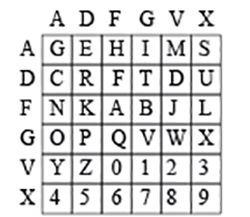
**This Polybius square, used by the ADFGVX system, was constructed from the phrase
Geheimschrift der Funker ("the operator's cipher").**
Take the message "Attack tomorrow at 4." Each letter is encrypted using the square: A is encoded as FF (the row and column containing A in the square), and so on. This gives the sequence FF DG DG FF GF DX AD VD FF XA AF.