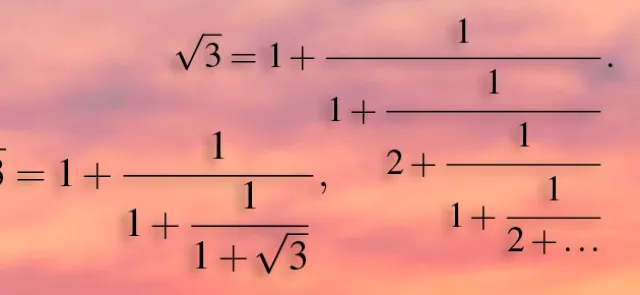
The world would undoubtedly be simpler if everything could be measured by integers—or, to leave nothing and no one out, by ratios of integers: a world in which everything would be commensurable. This idea, central to Pythagorean philosophy, was soon undermined by a discovery: some numbers are not rational (they cannot be written as fractions of integers). The number is a famous example, perhaps historically the first to be recognized as irrational (something that can be proved quite easily by contradiction).
Irrational square roots
The question of incommensurability lies at the heart of a passage in Plato's Theaetetus, a dialogue about knowledge. One page of the text remains famous among scientists:
"Theodorus here was drawing something for us about powers, showing that those of three feet and five feet are incommensurable in length with the one-foot line. He continued the same proof, taking each power in turn as far as that of seventeen feet, but something stopped him there. So this idea occurred to us: since it was clear that the powers are infinite in number, we should try to gather them into a single class, by which we could refer to them all as powers." (Theaetetus, 147e, trans. Michel Narcy, Garnier-Flammarion, 2016).
The translator's appendix includes two important notes that shed some light on the matter.