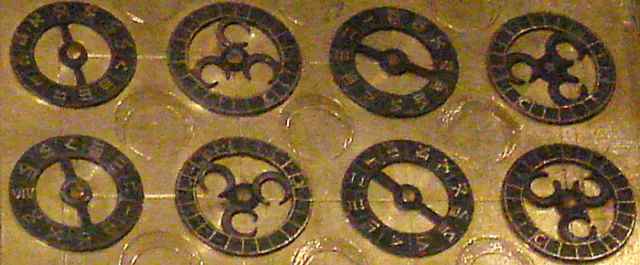
In military and diplomatic affairs, it is best to keep correspondence secret. Decrypting a single message can decide the outcome of a battle or negotiation. This happened in 1626, when Prince de Condé's troops, then besieging Réalmont, intercepted a messenger leaving the town with an incomprehensible message. Condé summoned a young mathematics teacher from the region, Antoine Rossignol des Roches (1600–1682), who deciphered it. The message said that the town was running out of ammunition. Condé had the decrypted message delivered to the town, which surrendered. The battle was won! The message had probably been produced using a cipher alphabet, in which each letter is replaced by a symbol—a system very much in vogue at the time.
Codebreaking draws on both mathematics and linguistics (see our article Exploring cryptographic machines). Even when this technique was improved by giving common letters several different encodings and adding nulls (symbols with no meaning), its weaknesses led Rossignol to devise coded dictionaries: bilingual dictionaries in which one language is French and the other consists of numbers. These made it possible to encode not only letters, in several different ways as before, but also syllables and words. Frequency analysis then becomes meaningless, while the probable-word method becomes difficult to use. Their main drawback is their vulnerability to espionage and the fortunes of war…
The Zimmermann telegram
-----------------------------
The famous Zimmermann telegram was encrypted with a code of this kind. Its decryption prompted the United States to enter the war in 1917, since Germany used it to propose an alliance with Mexico against the United States.
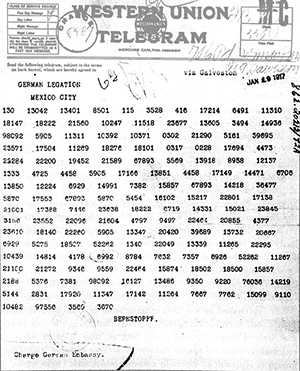
Original text of the Zimmermann telegram.