



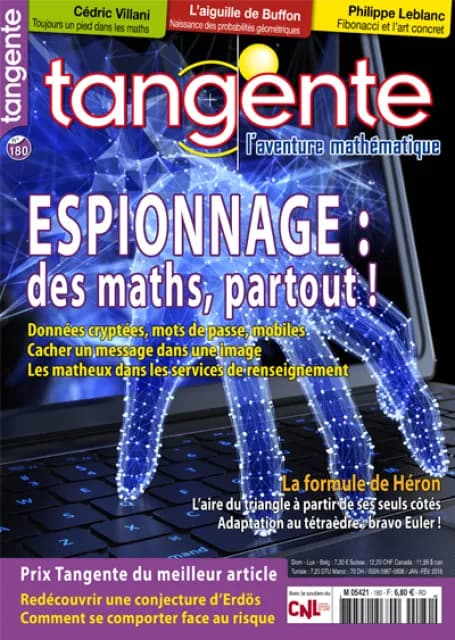
Mathematics and Espionage
This issue is not fully translated into English yet; only translated content is shown.
Read the French versionAll folders in this issue
Mathematics and Espionage
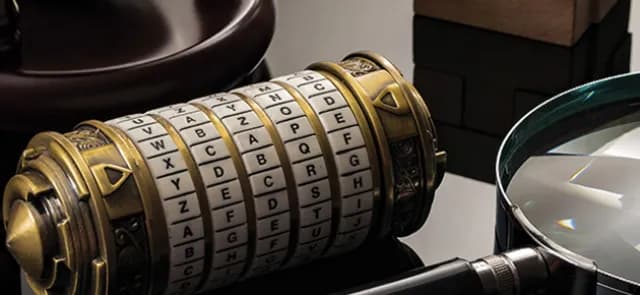
One is sometimes surprised to learn it, but intelligence agencies employ many mathematicians. To such an extent that they are probably the first employers for the profession! The usefulness of cryptology to encrypt or to decrypt confidential messages is no longer in question. But in a world of information submerged by digital data that circulates (too?) freely, securing transactions, searching for the "right" file have become highly strategic issues. Combinatorics, probabilities, statistics, data analysis... have become indispensable and will only continue to develop. Do you want to be a spy, become the next Matha (sic.) Hari? You know what you have left to do!

Heron's formula
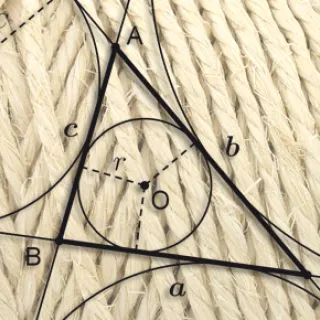
It comes to us from Antiquity and is a jewel of plane geometry. Much more recent and lesser-known than the theorems of Thales and Pythagoras, Heron's formula makes it possible to determine the area of a triangle using only the knowledge of the length of its sides. This is only the tip of the iceberg because this geometric nugget generalizes greatly beyond the triangle. Thus, the brilliant Euler found a stunning version for the tetrahedron. Brahmagupta and then Bretschneider proposed a variant for quadrilaterals. Finally, like its illustrious predecessor the Pythagorean theorem, Heron's formula can give rise to astonishing arithmetic research, such as that of "Heronian triplets". Welcome to geometry!
All articles in this issue
Points and lines: let the maths festivities begin!
On a sheet of paper, you doodle a few points, join them with lines... and you're off! Trial and error, attempts, mistakes, partial successes, a conjecture... It's all there. Mathematics—graph theory in particular—joins the party.
Behaving rationally in the face of risk
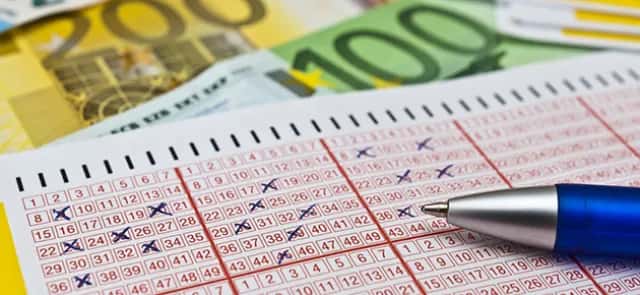
Faced with a lottery offering two different prizes, people adopt different strategies. Why do some participants prefer a potential prize that is not the largest? Their choices depend on how each person conceives of probability—whether as a one-off event or one that will be repeated.

Buffon and chance in geometry
In a 1733 paper, the Comte de Buffon introduced what is now known as "Buffon's needle problem." This experiment illustrates a field of mathematics that is flourishing today: stochastic geometry, with its many applications ranging from telecommunications to medical imaging.
Accessorizing with maths
The latest trendy creations for mathematical fashion lovers
Cédric Villani at the height of his powers
Despite an extremely busy schedule, our most mathematically minded MP still pursues a few mathematics outreach activities...
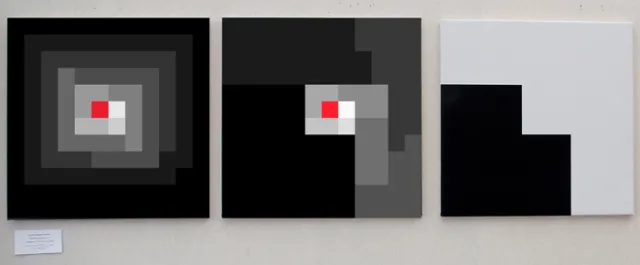
When Fibonacci meets concrete art
The famous Fibonacci sequence begins 1, 1, 2… and each term is the sum of the previous two. It abounds in surprising properties. Has it finally yielded all its secrets? That remains a mystery, as some artists are now working with it and exploring it from every angle.