



Heron's formula
It comes to us from Antiquity and is a jewel of plane geometry. Much more recent and lesser-known than the theorems of Thales and Pythagoras, Heron's formula makes it possible to determine the area of a triangle using only the knowledge of the length of its sides. This is only the tip of the iceberg because this geometric nugget generalizes greatly beyond the triangle. Thus, the brilliant Euler found a stunning version for the tetrahedron. Brahmagupta and then Bretschneider proposed a variant for quadrilaterals. Finally, like its illustrious predecessor the Pythagorean theorem, Heron's formula can give rise to astonishing arithmetic research, such as that of "Heronian triplets". Welcome to geometry!
All articles in this folder

A high-flying formula
Most of us learned how to use a compass to construct a triangle from the lengths of its three sides. Those three numbers are enough to determine a triangle. But how can we find its area from those data alone? That is precisely what Heron's formula does.
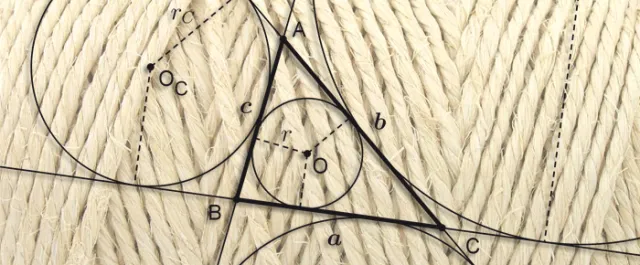
A nest of theorems
Heron's formula is strikingly simple. All the more remarkably, it provides a highly effective way to prove other, equally elegant results. It even leads to more fascinating problems in geometry!

Heron in space
Heron's formula extends to quadrilaterals and tetrahedra, as well as to all polyhedra, yielding many applications that remain relevant today.