Euler's 3D "Heron's formula"
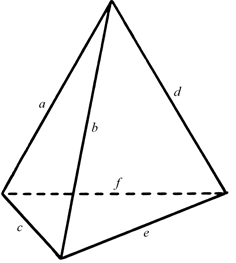
As with a triangle in the plane, a tetrahedron is completely determined by the lengths of its six edges. So is there an analogue of Heron's formula for a tetrahedron?
Yes. The great Swiss mathematician Leonhard Euler (1707–1783), apparently drawing on Tartaglia's work during the Renaissance, discovered such a formula for a tetrahedron. In this formula, a, b, c, d, e and f are the edge lengths of the tetrahedron, with edge a opposite e, edge c opposite d, and edge b opposite f. The volume of the tetrahedron—the three-dimensional analogue of a triangle's area—is denoted V. Thus:
122 V2 = (a 2e 2 + b2 f 2 + c 2d 2)(a 2 + b 2 + c 2 + d 2 + e 2 + f 2) – 2(a 2e 2 (a 2 + e 2)
\+ b 2f 2(b 2 + f 2)+ c 2d 2(c 2 + d 2)) – (a 2b 2d 2 + a 2c 2f 2 + b 2c 2e 2 + d 2e 2f 2).